
Description
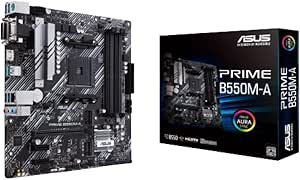
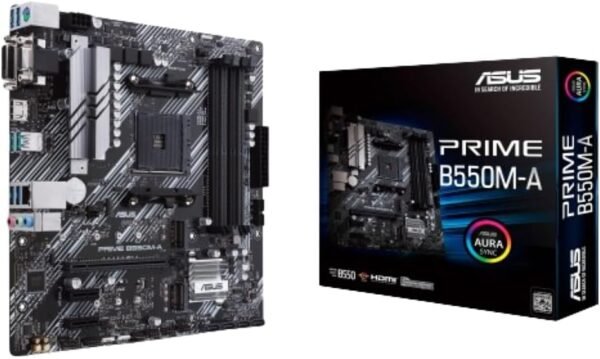
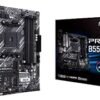
The ASUS Prime B550M-A WiFi II is a Micro ATX motherboard for AMD’s AM4 socket, built on the B550 chipset. ASUS lists PCIe 4.0, WiFi 6, 1Gb LAN, ECC memory support, HDMI 2.1 output and an RGB header. The Prime line is ASUS’s mainstream range, below the TUF Gaming and ROG boards, aimed at general purpose builds rather than at enthusiasts. The listing dates to July 2022.
Compatibility First
The socket is AMD AM4. The chipset is B550. The form factor is Micro ATX. Memory is DDR4, which is not interchangeable with DDR5 in either direction.
ASUS names 3rd Generation AMD Ryzen processors in its description. The listing does not enumerate other AM4 generations and says nothing about BIOS revisions anywhere. If you plan to fit a processor from a different Ryzen family, look your exact model up on ASUS’s own CPU support list for this board and note which BIOS revision it requires. On AM4, processor support across generations is a firmware question as much as a socket question, and a product description is not a substitute for the support list.
Be clear that AM4 is the previous generation AMD platform. There is no upgrade path from this board to a current Ryzen 9000 series processor, which uses the AM5 socket and DDR5 memory. That makes boards like this attractive when you already own AM4 parts or DDR4 memory, and less attractive as the base for a system you expect to upgrade.
ECC Memory Support Is the Unusual Part
ASUS lists ECC memory support in the product title, and this deserves attention because it is rare at this level and it changes what the board is good for.
ECC stands for error correcting code. ECC memory modules carry additional chips that let the memory controller detect and correct single bit errors as they occur, rather than allowing a flipped bit to propagate into your data. Cosmic rays and electrical noise genuinely do flip bits in memory, and on most desktops the result is an occasional crash or a corrupted file that nobody traces back to its cause.
For gaming and general use, ECC is unnecessary. For a machine that stores data over long periods, runs a file server, hosts virtual machines or does long computational work, it is meaningful protection. A board that supports it in a Micro ATX form factor, with a consumer processor, is a genuinely useful option for a home server or a small workstation. That said, ECC support requires ECC modules, which cost more and are less widely available, and it requires a processor that supports ECC. Check both before assuming you can use the feature.
Connectivity and Expansion
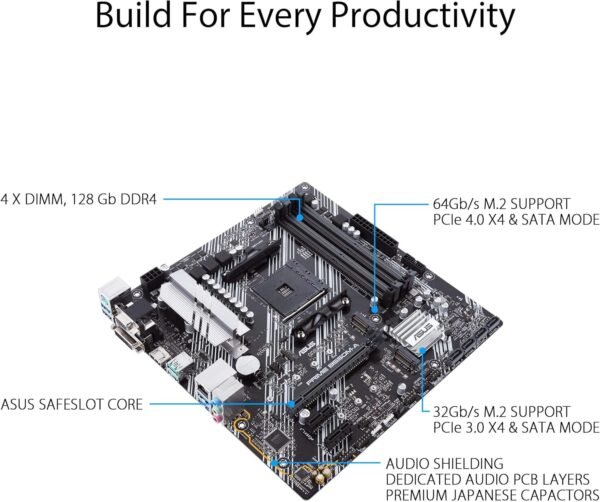
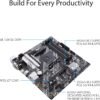
PCIe 4.0 is the headline of the B550 chipset generation, providing doubled bandwidth per lane over PCIe 3.0 for the primary graphics slot and one M.2 slot, with the chipset’s own downstream lanes at the older generation. For a single graphics card and one fast NVMe drive, that arrangement covers the components that benefit.
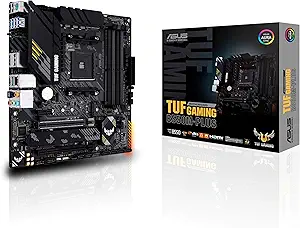
WiFi 6 is included on the board, which removes the need for a separate wireless card and frees an expansion slot on a Micro ATX layout where slots are scarce. It requires a WiFi 6 router to deliver its advantages, and falls back to earlier standards otherwise. If you were building on a board without wireless, such as the ASUS TUF Gaming B550M-PLUS, you would need a card such as the TP-Link Archer TX3000E and the slot to put it in. Wired networking here is 1Gb LAN rather than the 2.5Gb found on some competing boards.
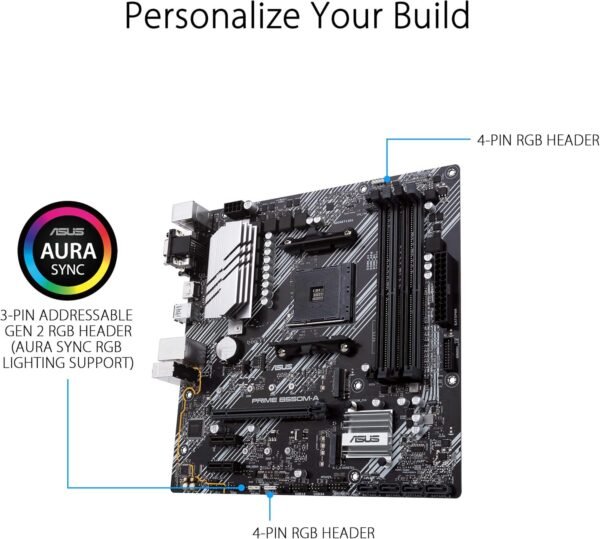
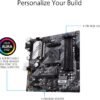
HDMI 2.1 is listed for display output, and as on any AMD board that output requires a processor with integrated graphics. Many Ryzen desktop processors have none, in which case a discrete graphics card is mandatory. An RGB header is provided for lighting.
Highlights
- AMD AM4 socket with the B550 chipset in a Micro ATX board.
- Listed support for 3rd Generation AMD Ryzen processors.
- PCIe 4.0 for the primary graphics slot and fast NVMe storage.
- ECC memory support, uncommon on a mainstream consumer board.
- Onboard WiFi 6 and 1Gb wired LAN.
- HDMI 2.1 display output for processors with integrated graphics.
- RGB header for lighting, in a black Micro ATX layout.
Things To Consider
The specification block lists a memory speed of 2133 MHz. That figure is the standard DDR4 base speed rather than the board’s supported maximum, and B550 boards routinely run memory considerably faster with the appropriate profile enabled. Do not read 2133 MHz as a limitation; check ASUS’s own memory support list for this board for the speeds it validates. The processor field simply reads “others”, which is not useful for anything.
Other entries in the block are packaging data: dimensions of 10.5 x 2.8 x 10.8 inches and a weight of 2.01 pounds describe the box, not a Micro ATX board, which measures 9.6 by 9.6 inches. A field reading 11 USB 2.0 ports is implausible as a rear panel count and probably totals headers and ports together.
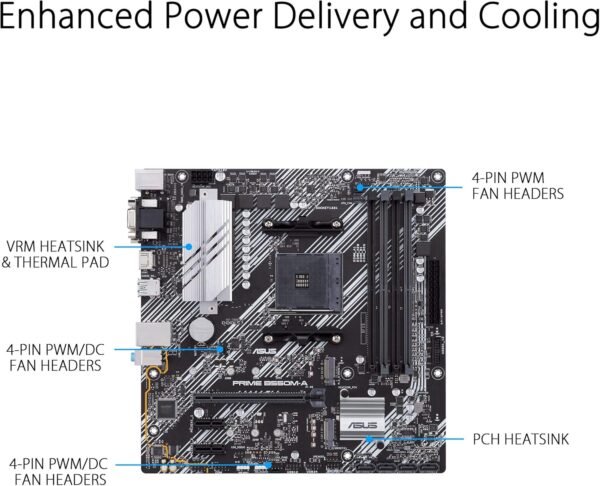
Specifications the listing does not state and which should be checked in ASUS’s documentation: the number of M.2 slots, the number of SATA ports, the number of memory slots and maximum capacity, the full rear panel port list, and how populating M.2 slots affects SATA availability. ASUS describes a robust power design and comprehensive cooling solutions without quantifying either, so this page makes no claim about sustained overclocking headroom.
Finally, note that the Prime line is positioned for mainstream builders rather than enthusiasts. That is appropriate for most people and it does mean the power delivery and heatsinking are specified for standard operation rather than for pushing a high core count processor hard. If you plan sustained heavy load, check reviews of the specific voltage regulation arrangement.
Who Should Buy It, and Who Should Not
Buy the Prime B550M-A WiFi II if you are building on AM4, you want WiFi 6 onboard rather than occupying an expansion slot, and PCIe 4.0 covers your storage and graphics needs. The ECC support makes it an unusually good candidate for a home server or a small workstation built on consumer parts, which is a use case few boards at this level serve.
Do not buy it if you are starting a new build with an eye on future processor upgrades, since AM4 is at the end of its life and the AMD Ryzen 5 7600X generation requires a different socket entirely. Do not buy it if you need 2.5Gb networking. Alternatives on the same chipset include the MSI MAG B550M Mortar MAX WiFi with faster wired networking, the Gigabyte B550 Gaming X V2 and the ASRock B550M Steel Legend. Our motherboards category covers both AMD sockets.