Description
What The UGREEN NASync DXP4800 Plus Is
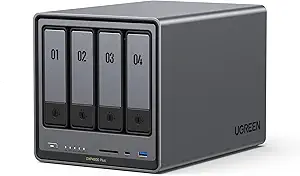
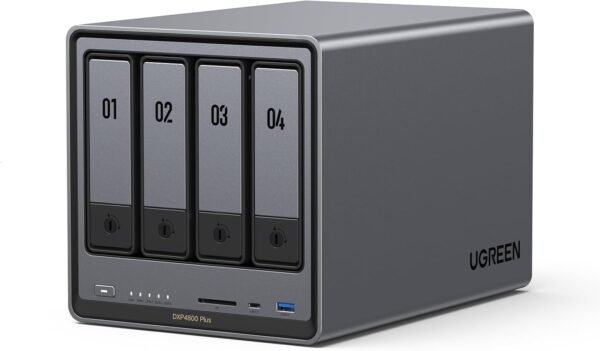
The UGREEN NASync DXP4800 Plus is a four bay desktop network attached storage enclosure with an unusually capable specification for its class. UGREEN lists an Intel Pentium Gold 8505 five core processor, 8GB of DDR5 memory, a 128GB solid state drive, one 10GbE and one 2.5GbE network port, two M.2 NVMe slots and a 4K HDMI output.
The word diskless in the product title is the first thing to register. Hard drives are not included. A four bay enclosure needs four drives to be useful, and on a NAS those drives are usually the largest single cost of the project, often exceeding the price of the enclosure itself. Anyone comparing this against a ready made competitor such as the Synology DS923+ should compare the total including drives rather than the enclosure alone.
Processor, Memory And Why They Matter Here
Most consumer NAS units run low power processors chosen for efficiency rather than performance. A Pentium Gold 8505 with five cores and 8GB of DDR5 is a considerably stronger foundation, and the practical consequences show up in three places: transcoding video for streaming to other devices, running containers or virtual machines on the NAS itself, and handling many simultaneous users without slowing down.
The 4K HDMI output is the specification that hints at how UGREEN expects some buyers to use this. A NAS with a video output can act as a media player connected directly to a television rather than only serving files across a network. The listing does not detail what software drives that output, so the exact capability should be confirmed before buying for that purpose.
Storage Layout
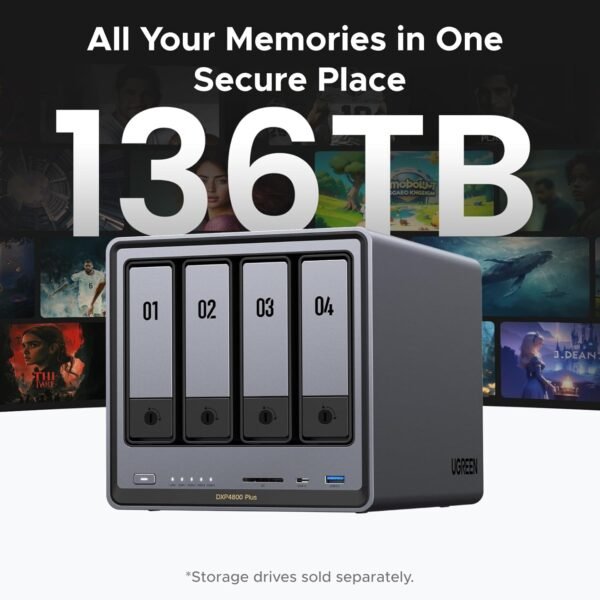
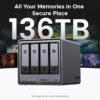
Storage is arranged in two tiers. Four bays take conventional 3.5 inch drives for capacity, and two M.2 NVMe slots take solid state drives, typically used as a cache or as a fast pool for active work. A 128GB SSD is included, which normally holds the operating system so that the drive bays are free for data. UGREEN quotes a maximum capacity of 136TB, a figure that combines the four bays and the M.2 slots at the largest drive sizes available.
Networking And Transfer Claims
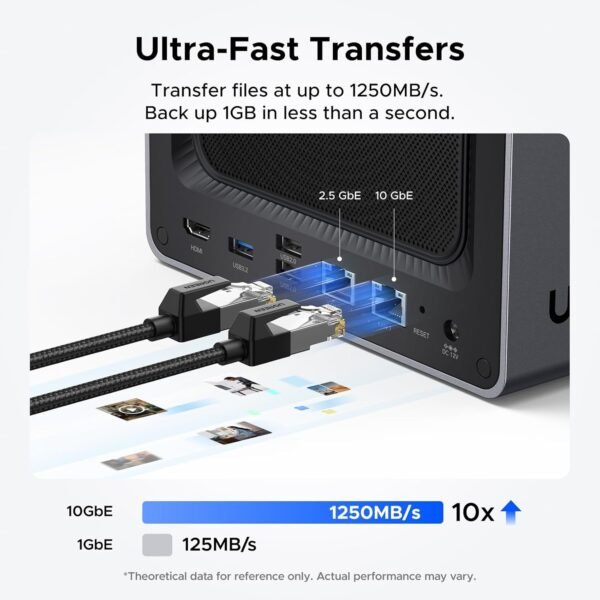
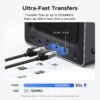
Two network ports are fitted: one 10GbE and one 2.5GbE. A 10 gigabit port on a consumer NAS is the specification that separates this from mainstream units, most of which offer 1GbE or 2.5GbE. UGREEN states that a gigabyte can be backed up in less than a second using either the 10GbE network port or the 10Gbps USB ports.
That claim needs context rather than repetition. A 10 gigabit link can move roughly a gigabyte per second in ideal conditions, so the arithmetic is plausible, but it depends on the drives sustaining that rate, on the client machine having a 10GbE port of its own, and on a 10 gigabit capable switch sitting between them. Very few homes have that infrastructure, and mechanical hard drives in a four bay array will not sustain 10 gigabit speeds on their own. The figure describes the ceiling of the port, not the speed a typical setup will see. Anyone building toward it also needs the network side, which is where equipment such as the Ubiquiti Dream Machine Special Edition becomes relevant.
One area the listing describes only in general terms is the software. UGREEN mentions RAID options for recovery if a drive fails, remote access, advanced encryption and flexible permission management, all through its own application. On a NAS the software is at least as important as the hardware, because it determines backup scheduling, snapshot support, application availability and how updates are delivered over the years the unit is in service. None of that detail appears here, and it is the area where a newer NAS vendor differs most from an established one.
Highlights
- Four drive bays plus two M.2 NVMe slots.
- Intel Pentium Gold 8505 five core processor.
- 8GB of DDR5 memory.
- 128GB SSD included for the system.
- One 10GbE network port.
- One 2.5GbE network port.
- 4K HDMI output.
- RAID options described for recovery if a drive fails.
- Remote access and permission management through UGREEN software.
- UGREEN quotes up to 136TB total capacity.
Things To Consider
The marketing figures on this listing are all ceilings rather than expectations, and they should be read that way. The 136TB capacity assumes the largest drives on the market in every bay and both M.2 slots. The claim of 39 million photos or 76,000 movies is derived from that same maximum. The one gigabyte per second backup figure assumes 10 gigabit infrastructure at both ends. None of those are wrong, and none of them describe a typical installation.
- Drives are not included. Four drives are a significant additional cost.
- The 136TB figure assumes maximum capacity drives in every slot.
- The 10GbE port only helps if the network and the client machine also run at 10 gigabit.
- Mechanical drives in a four bay array will not sustain 10 gigabit transfer rates.
- Drive noise and heat in a four bay desktop enclosure are worth planning for.
- Software maturity matters on a NAS, and UGREEN is newer to this market than the established vendors.
- No power consumption figure is published.
- Whether the memory and the included SSD are user upgradable is not stated.
Who Should Buy It And Who Should Not
This suits someone who wants a private storage server with real processing power behind it: media libraries with transcoding, container workloads, photo archives with local indexing, or a small business that needs shared storage with permission control. The 10GbE port and the M.2 cache slots make it a sensible foundation for a machine expected to keep pace with a fast network for several years, and the Pentium processor removes the usual bottleneck of consumer NAS hardware.
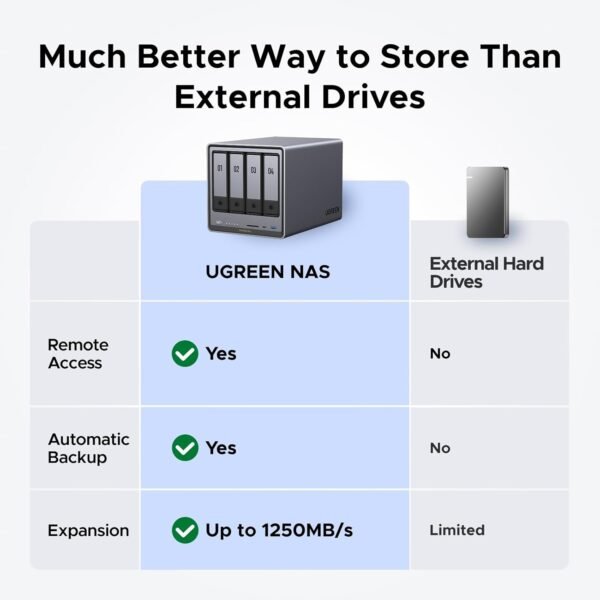
It is the wrong purchase for anyone who just wants a bigger external drive, where a simple enclosure or a two bay unit is far cheaper. It is also the wrong choice for anyone unwilling to budget for four drives on top of the enclosure. Buyers comparing established software ecosystems should look at the Synology RackStation RS1221+ or the Asustor AS5402T, and those who would rather build their own machine should look at a NAS case such as the JONSBO N2 in the enclosures category.
