

Description
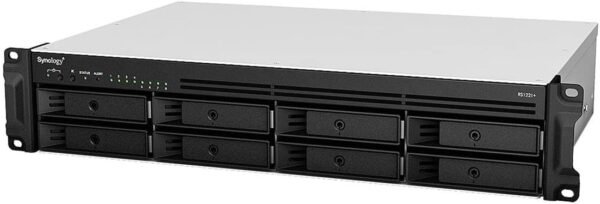
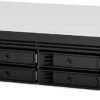
The Synology RackStation RS1221+ is an eight bay, 2U rackmount network attached storage unit sold diskless. It runs Synology’s DiskStation Manager operating system, which is the main reason people buy Synology hardware rather than assembling their own storage server, and it is aimed at small businesses centralizing file storage, backups and shared project data.
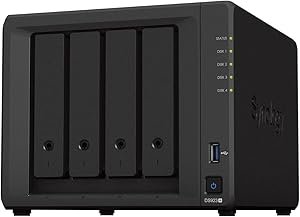
Anyone who does not have a rack should stop here and look at desktop units instead. The Synology DS923+ covers the same software platform in a desktop chassis, and alternatives include the Asustor AS5402T and the UGREEN NASync DXP4800 Plus.
Form Factor And Why Short Depth Matters
The defining physical characteristic of this model is its depth. Synology states the RS1221+ measures just 298 mm deep, and notes that the redundant power supply variant, the RS1221RP+, is 399 mm. Standard rackmount servers are commonly 600 to 750 mm deep, which means they will not fit in a shallow wall mounted rack, a comms cabinet or an audio visual rack.
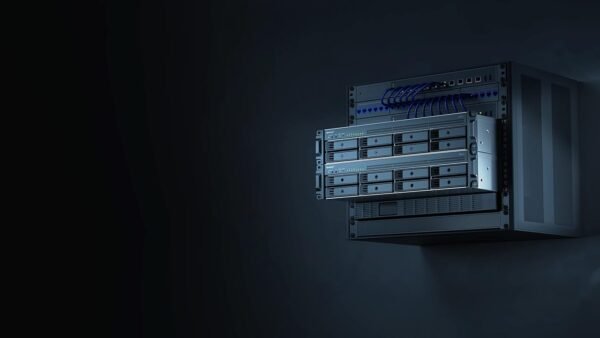
A 298 mm chassis fits in those places. For a small business with a wall cabinet rather than a server room, or for an office where the rack sits in a cupboard, that single dimension is what makes the product usable at all. Two rack units of height with eight drive bays is also a dense arrangement, achieved by mounting the drives horizontally rather than vertically.
Performance Figures And What They Mean
Synology quotes up to 2,315 MB per second reading and 1,147 MB per second writing, framed around handling multi user environments. Those figures need context the listing does not supply. A single gigabit Ethernet connection tops out around 110 MB per second, so numbers in the thousands can only be reached through link aggregation across several ports or through an add in high speed network card. The listing does not state which configuration produced them, nor what drives were installed, nor what test was used.
That connects to the second feature bullet, which states network performance can be improved by five times using a PCIe SFP+ or RJ-45 network card from Synology’s compatibility list. The presence of a PCIe slot is genuinely valuable on a NAS at this level, since it allows a 10 gigabit upgrade later without replacing the unit. The compatibility list is a real constraint though: Synology validates specific cards and support outside that list is not guaranteed.
High Availability And The DSM Platform
Synology High Availability allows two identical units to be configured as a cluster, with one taking over from the other in the event of a failure. Synology describes failover at the minute level, which is honest: this is not instantaneous failover, and a minute of downtime is still downtime, but it is far better than restoring from backup. Running SHA requires buying two units, which doubles the hardware cost, so it belongs in environments where file service outages have a real business cost.
DiskStation Manager is the other half of the value. It provides the volume management, snapshot, replication, backup and access control tools that make a NAS more than a box of disks, and Synology emphasizes its data protection options for small business environments. The listing does not enumerate which DSM packages are included or licensed separately, and some Synology features do require additional licenses, so buyers with specific requirements should check before ordering.
Installation Practicalities
A 2U chassis occupies two rack units, which is 3.5 inches of vertical space, and it needs rails or shelf support rated for the loaded weight. The listed 19.36 pounds is the empty weight, and eight drives will add several pounds more, so a wall mounted cabinet needs to be checked against its stated load limit before mounting anything.
Power and cabling deserve planning as well. The base RS1221+ has a single power supply, and the redundant supply variant is the RS1221RP+, which is also the deeper of the two at 399 mm. Anyone who needs power redundancy is buying the other model, and the extra 101 mm of depth may not fit the same cabinet. That is a decision to make before ordering rather than after.
Highlights
- Eight drive bays in a 2U rackmount chassis.
- Short 298 mm depth for shallow racks and cabinets.
- Up to 2,315 MB per second read and 1,147 MB per second write, per Synology.
- PCIe slot for an SFP+ or RJ-45 network card from Synology’s compatibility list.
- Synology High Availability clustering with two units.
- Runs DiskStation Manager with its data protection tool set.
- Listed weight of 19.36 pounds without drives.
Things To Consider
The listing is missing most of the specifications a buyer at this level needs. There is no processor model, no memory capacity, no maximum memory, no count of built in Ethernet ports, no statement of supported drive types or maximum drive capacity, no RAID levels listed, no power supply rating and no noise figure. For a business storage purchase those are not optional details. Synology publishes them on its own product page and buyers should work from there rather than from this listing.
Diskless is the point worth repeating because it is easy to overlook in the total cost. Eight drives are a substantial additional purchase, and Synology maintains a compatibility list for those too. Rackmount hardware is also loud by design, using small high speed fans, and the listing gives no acoustic figure. This unit belongs in a rack room or a cupboard, not in an occupied office.
Customer feedback is good at 4.6 stars across 174 ratings, on a product first available in January 2021. That is a reasonable sample for a business product and a strong average. The listed dimensions of 23 by 16.5 by 8.5 inches describe the shipping package rather than the 2U chassis. Readers can compare other storage in the enclosures category and the devices category.
Who It Suits
The RS1221+ suits a small business or a workgroup that already has a rack or a shallow wall cabinet, needs eight drives of shared storage with proper snapshot and backup tooling, and wants the option to add 10 gigabit networking later. Organizations that cannot tolerate file service downtime can pair two units into a high availability cluster.
It is the wrong purchase for a home or a small office without a rack, where a desktop Synology unit does the same job more quietly and for less. It is also wrong for anyone who has not budgeted for eight drives on top of the chassis, and for buyers who need the processor, memory and port specifications confirmed before ordering, since this listing omits all of them.