Description
What The ASUS TUF Gaming Z690-Plus WiFi Is
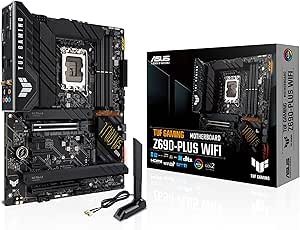
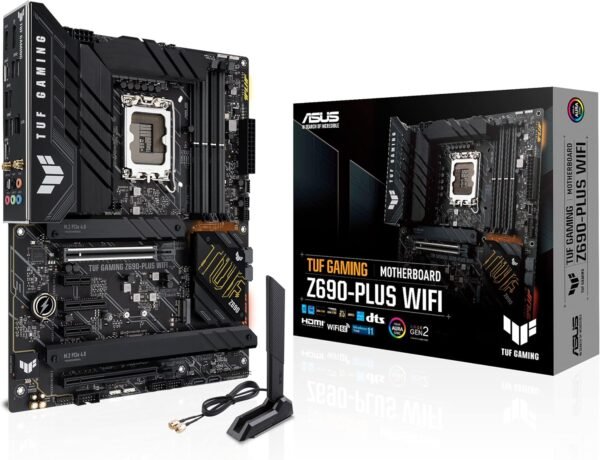
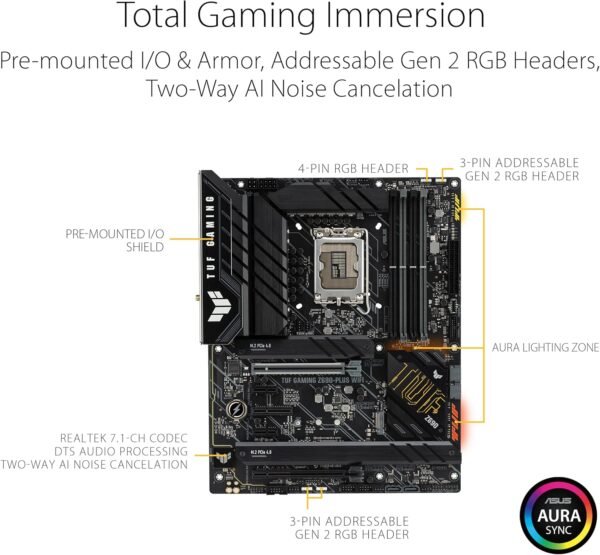
The ASUS TUF Gaming Z690-Plus WiFi is a full size ATX motherboard, and unusually for this catalog the listing states the compatibility basics clearly in the product name: Intel LGA 1700 socket, Z690 chipset, ATX form factor, PCIe 5.0, DDR5, four M.2 NVMe sockets, 14+2 power stages, WiFi 6, 2.5Gb LAN, front USB 3.2 Gen 2 Type-C ports and Thunderbolt 4. That is the whole compatibility picture in one line, which is exactly what a motherboard buyer needs first.
TUF Gaming is the durability oriented tier in the ASUS range, positioned below ROG Strix. ASUS describes the board as engineered with military grade components, an upgraded power solution and a comprehensive cooling system for stable performance during long sessions. In practice that means a board built for a mainstream gaming or workstation build rather than for record chasing overclocking, and it sits between the ASUS ROG Strix Z690-E Gaming above it and value Z690 boards below.
Processor Support And What Is Not Stated
The listing says the board is ready for 12th Gen Intel Core processors on the LGA 1700 socket. That is the only generation named. It does not state support for 13th Gen or 14th Gen processors, and it makes no statement about BIOS versions or about a BIOS update being required for a newer chip. Because the same LGA 1700 socket carried multiple processor generations, that gap matters: a buyer intending to fit a later generation CPU should check the ASUS support page for this exact board and confirm both the CPU support list and the BIOS version, rather than assuming the socket alone guarantees compatibility.
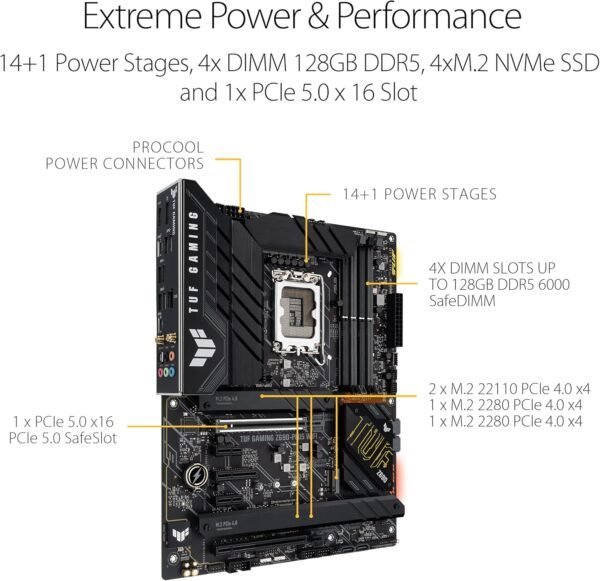
Power delivery is quoted as 14+2 DrMOS power stages with ProCool sockets, military grade TUF components and Digi+ VRM. Fourteen stages on the core rail is a substantial arrangement for a mid tier ATX board and is the specification most relevant to running a high core count processor at sustained load. Manageability features listed include Wake on LAN by PME and PXE boot, both of which matter in managed or headless setups more than in a gaming build.
Memory
Memory is DDR5. The specification table lists a memory speed of 2133 MHz, which is a base rate rather than the speed most buyers will run, and the listing does not state a maximum supported memory frequency or capacity anywhere. That is a real gap, because on DDR5 the supported overclocked frequency range is one of the main differences between boards. Buyers with a specific memory kit in mind should check the qualified vendor list for this model.
Storage, Cooling And Networking
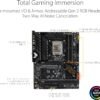
Four M.2 NVMe sockets is the headline storage figure and it is generous for the tier. Combined with PCIe 5.0 on the graphics slot, that gives a build room to grow without add in cards. The listing also names a front panel USB 3.2 Gen 2 Type-C header, which is the connector that lets a modern case front panel actually run at speed instead of falling back to older USB.
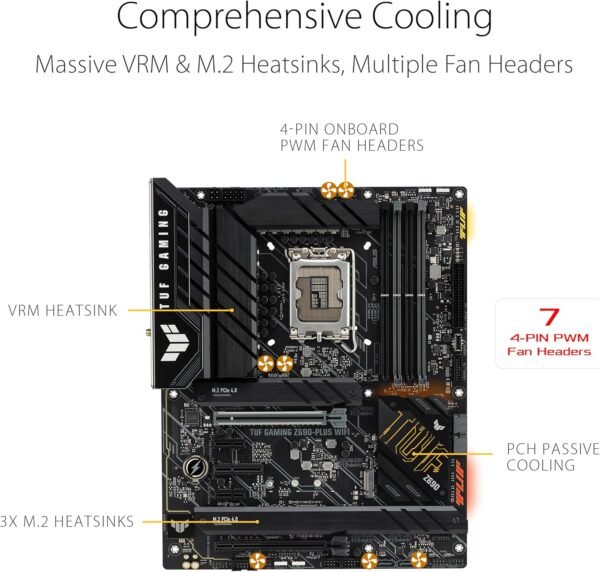
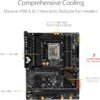
Cooling hardware is listed as a VRM heatsink, a fanless chipset heatsink, an M.2 heatsink, hybrid fan headers and the Fan Xpert 4 utility. Hybrid headers accept both pulse width modulation and voltage controlled fans, which makes reusing existing case fans straightforward. Networking is WiFi 6 using the AX201 module plus Intel I225-V 2.5Gb wired LAN, with TUF LANGuard surge protection and TurboLAN traffic prioritization software. A board like this pairs naturally with a mid to high tier graphics card such as the MSI GeForce RTX 4070 Super.
Highlights
- LGA 1700 socket and Z690 chipset, both stated in the listing.
- Full ATX form factor.
- PCIe 5.0 support and DDR5 memory.
- Four M.2 NVMe SSD sockets.
- 14+2 DrMOS power stages with Digi+ VRM.
- WiFi 6 AX201 and Intel I225-V 2.5Gb LAN.
- Front panel USB 3.2 Gen 2 Type-C header.
- Thunderbolt 4 named in the product title.
- VRM, chipset and M.2 heatsinks with hybrid fan headers.
- Wake on LAN and PXE boot support.
Things To Consider
The physical figures on this listing are wrong and should be ignored. Product dimensions are given as 8.66 by 3.15 by 1.18 inches, which is not an ATX board, since ATX is a 12 by 9.6 inch standard. Item weight is listed as 2 pounds, which is plausible for a boxed board but not stated as such. The Wireless Type field lists both 802.11a/b/g/n/ac and 802.11ax, which is simply the full backward compatible list for a WiFi 6 module rather than two different radios.
- Only 12th Gen Intel Core support is stated. Later generations are not mentioned and a BIOS requirement is not addressed.
- The memory speed field lists 2133 MHz and no maximum supported frequency is given.
- Thunderbolt 4 appears in the product title but is not detailed in the description, so the implementation should be confirmed.
- Z690 is a previous generation chipset, which affects long term upgrade options.
- Filling all four M.2 sockets on Z690 boards commonly disables SATA ports, so check the shared bandwidth table.
- Product dimensions in the specification table do not describe an ATX board.
Who Should Buy It And Who Should Not
This board suits a builder committed to the LGA 1700 platform who wants strong power delivery, four M.2 sockets and 2.5Gb networking without paying ROG prices. The durability positioning and the heatsink coverage make it a reasonable base for a machine that runs hard for long stretches, and the port and header selection is complete enough that few add in cards are needed. It compares closely with the GIGABYTE Z690 AERO G on features while taking a different design approach.
It is the wrong purchase for anyone starting a build from scratch today, since a current generation chipset offers a longer upgrade path, and for anyone who needs a compact system, where a Mini ITX board such as the ASRock Z790M-ITX WiFi fits instead. Buyers who want the newest Intel chipset tier should compare the ASUS ROG Strix Z790-A Gaming and the rest of the motherboards category before deciding.