Description
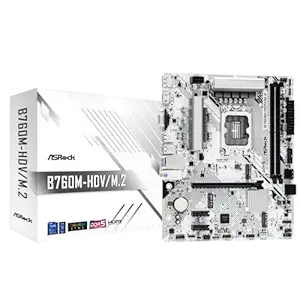
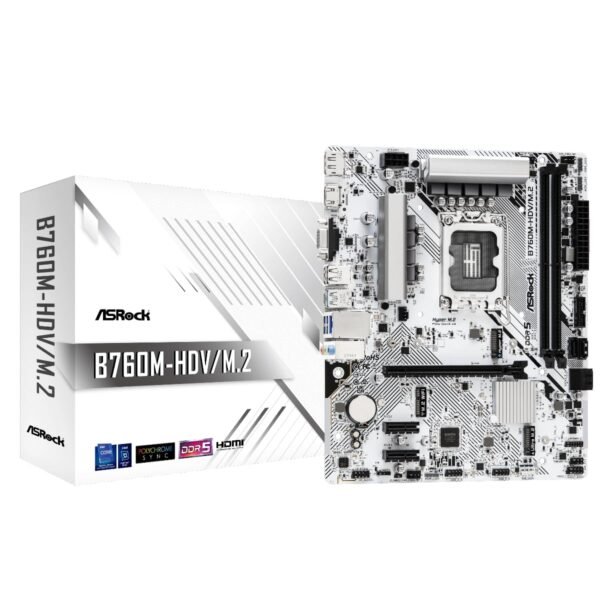
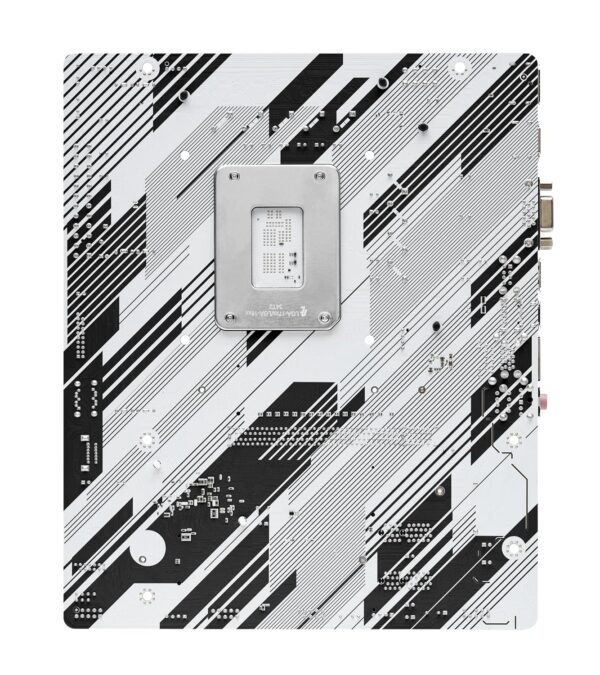
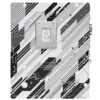
The ASRock B760M-HDV/M.2 is a Micro ATX motherboard for Intel’s LGA1700 socket, built on the B760 chipset with DDR5 memory support. ASRock lists it as compatible with 13th generation, 12th generation and next generation Intel Core processors, and specifies a 7+1+1 power phase arrangement. It is an entry to mid tier board: the feature list is complete rather than lavish, and it is aimed at builders who want a current platform without paying for enthusiast extras.
Compatibility First
The socket is LGA1700. The chipset is B760. The memory is DDR5, which is not interchangeable with DDR4 in either direction, so a DDR4 kit you already own will not work on this board. The form factor is Micro ATX, measuring 9.6 by 9.6 inches by the standard, which fits most cases but should still be checked against a compact enclosure.
ASRock names 13th generation and 12th generation Intel Core processors explicitly, and adds “next gen” without naming the generation. That vagueness is worth taking seriously rather than reading as reassurance. The listing says nothing about BIOS revisions or firmware requirements anywhere. If you intend to fit a processor from a generation the listing does not name outright, look up your exact model on ASRock’s own CPU support list for this board and note the BIOS version it requires before buying either part. A current part such as the Intel Core i7-14700 is precisely the case where that check is not optional.
On memory, ASRock quotes DDR5 support up to 7200 MHz with an overclocking qualifier. That figure is a ceiling under favorable conditions, not a guaranteed operating speed, and reaching high DDR5 speeds depends on the memory kit, the processor’s memory controller and how many modules are installed. Check ASRock’s memory support list for this board before buying a kit specifically for its rated speed.
Expansion, Storage and Ports
Slots
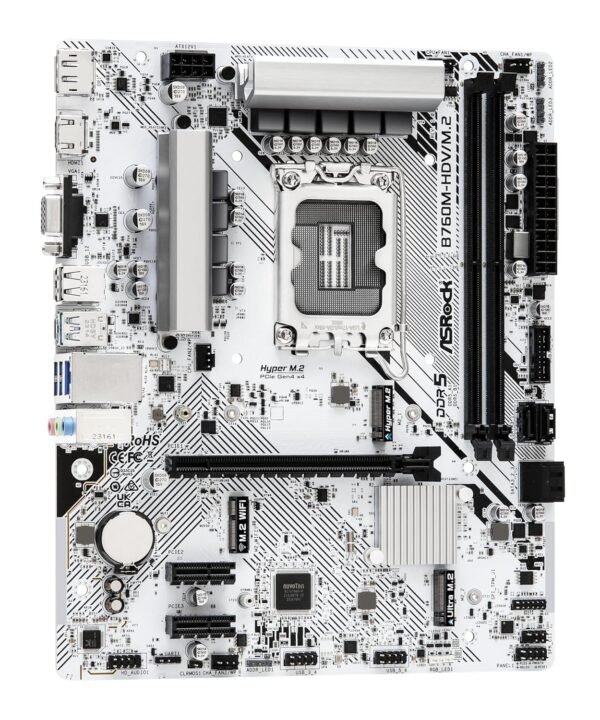
The board provides one PCIe 4.0 x16 slot and two PCIe 3.0 x1 slots. That is a sensible allocation for a build with one graphics card and a couple of small expansion cards, and it is worth noting the primary slot is Gen4 rather than Gen5. For current graphics cards that makes no practical difference; it would matter for a Gen5 device that saturates the link, which is not a mainstream scenario yet.
There is also an M.2 Key E slot intended for a wireless module. This board has no onboard Wi-Fi, and the Key E slot is how you add it. That is a smaller and cheaper route than a PCIe card, though it requires buying a compatible module and running antenna leads. The alternative is a full card such as the TP-Link Archer TX3000E, which would occupy the x16 slot’s neighbor rather than the Key E socket.
Storage
Storage is well specified for the tier: four SATA3 ports, one Hyper M.2 slot at PCIe Gen4 x4 and one Ultra M.2 slot at PCIe Gen3 x4. The distinction between the two M.2 slots is the one to plan around. A fast NVMe drive belongs in the Gen4 slot; a secondary drive can live in the Gen3 slot without noticeable cost for most uses. As on almost every board, populating M.2 slots can disable some SATA ports, and ASRock’s manual holds the allocation table.
Rear and front panel
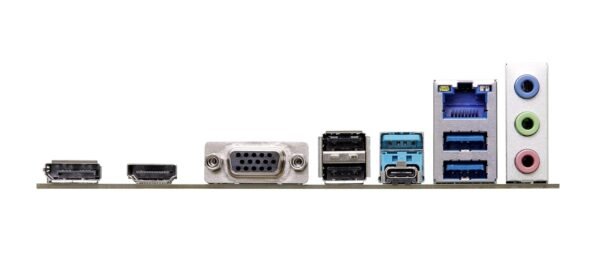
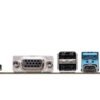
ASRock lists the USB arrangement precisely, which is unusual and helpful: one USB 3.2 Gen1 Type-C on the rear, five USB 3.2 Gen1 Type-A of which three are rear and two are front panel headers, and six USB 2.0 ports of which two are rear and four are front. That is a good count for a Micro ATX board, though note that every port on it is Gen1 rather than Gen2, so external drive throughput tops out lower than on higher tier boards.
Graphics outputs are HDMI, DisplayPort and D-Sub. The inclusion of D-Sub, the old analog VGA connector, is genuinely notable in 2023 and useful in offices, schools and workshops still running older monitors and projectors. All three outputs require a processor with integrated graphics; with a processor that has none, they do nothing. Networking is Dragon 2.5G LAN, which is a step above gigabit and needs 2.5 Gb capable network equipment to deliver more. Audio is a Realtek ALC897 codec with 7.1 channel support, which is the mainstream codec at this tier rather than a premium one.
Highlights
- Intel LGA1700 socket with the B760 chipset in a Micro ATX board.
- Listed support for 13th and 12th generation Intel Core processors.
- DDR5 memory with a quoted overclocked ceiling of 7200 MHz.
- 7+1+1 power phase arrangement for processor voltage delivery.
- One PCIe 4.0 x16 slot, two PCIe 3.0 x1 slots and an M.2 Key E slot for a wireless module.
- One Hyper M.2 at PCIe Gen4 x4, one Ultra M.2 at PCIe Gen3 x4 and four SATA3 ports.
- HDMI, DisplayPort and D-Sub video outputs.
- Dragon 2.5G LAN networking and a Realtek ALC897 7.1 channel audio codec.
Things To Consider
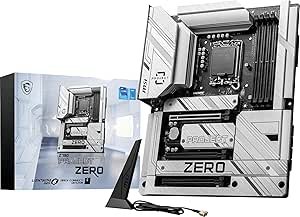
The 7+1+1 power phase arrangement is modest, and it is the honest limit of this board. Seven phases for the processor cores is adequate for mainstream chips and is not the arrangement you would choose for a high core count processor under sustained heavy load, where more phases spread current and heat across more components. The listing does not state whether the voltage regulation has heatsinks. If you plan to run a high tier processor at sustained full load, a board with stronger power delivery, such as the ASUS TUF Gaming Z690-Plus WiFi or the MSI Z790 PROJECT ZERO, is a more appropriate base.
Note also that B760 is not an overclocking chipset for the processor. Memory overclocking is supported, as the 7200 MHz figure indicates, but processor multiplier overclocking requires a Z series chipset. If you are buying an unlocked K processor specifically to overclock it, this is the wrong board.
The imported specification block is badly corrupted and should be ignored entirely. It lists product dimensions of 11.81 x 11.81 x 11.81 inches, an item weight of 0.035 ounces, a “type of item” of Video Game and a language field reading English. None of that describes a motherboard.
Finally, ASRock lists an Auto Driver Installer feature, which fetches and installs drivers after Windows setup. It is a convenience rather than a specification, and it is worth knowing it exists so you do not go hunting for a driver disc.
Who Should Buy It, and Who Should Not
Buy the B760M-HDV/M.2 if you are building a current Intel system on a budget, you want DDR5 and PCIe 4.0 without paying enthusiast prices, and your build uses a mainstream processor rather than a high tier one under constant load. The port count, the two M.2 slots and the 2.5 Gb networking are all more generous than the price tier usually allows, and the D-Sub output solves a real problem for anyone with older displays.
Do not buy it if you want to overclock the processor, if you need onboard Wi-Fi without adding a module, or if you plan to pair it with a top tier processor and run it hard. Small form factor builders should look at an ITX board such as the ASRock Z790M-ITX WiFi instead. Our motherboards category covers the wider range on both platforms.