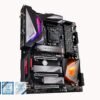
Description
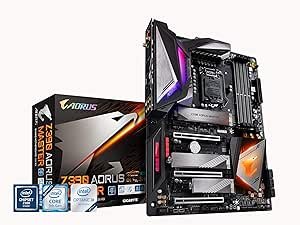
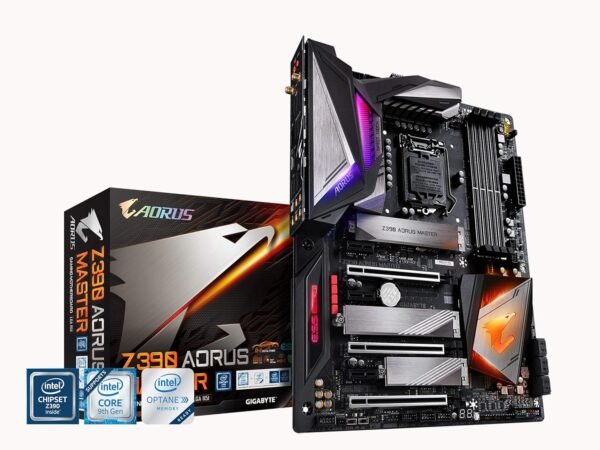
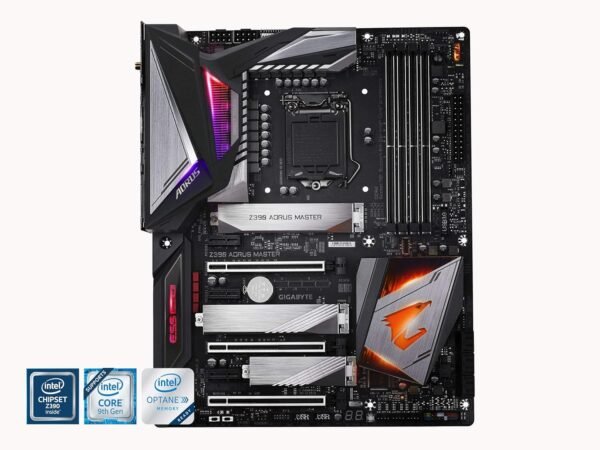
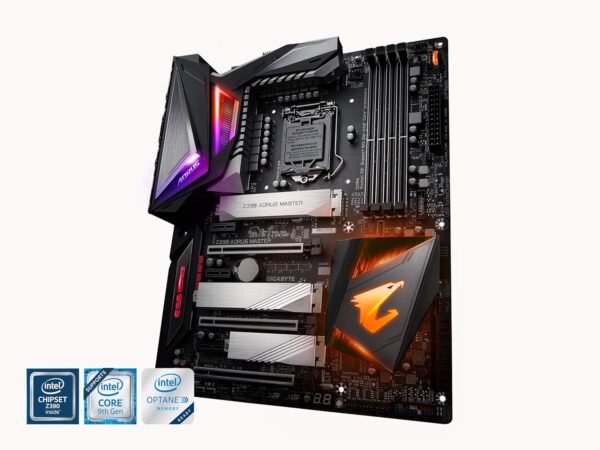
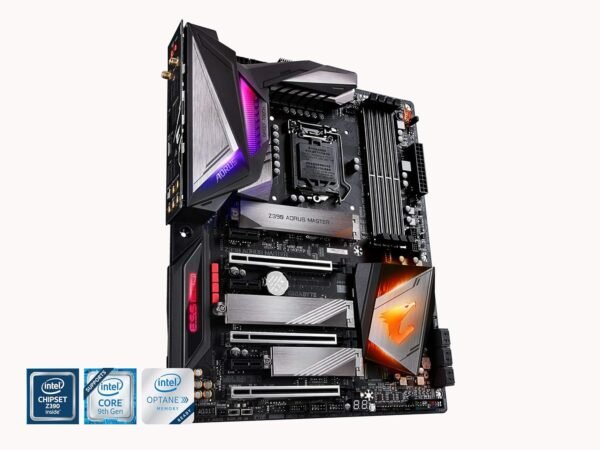
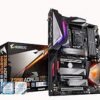
The GIGABYTE Z390 AORUS MASTER is a full size ATX motherboard for Intel’s LGA1151 socket, built on the Z390 chipset. It sits near the top of its generation’s range: GIGABYTE lists a 12 phase digital voltage regulation solution with power stages, three M.2 slots each under its own thermal guard, onboard Wi-Fi, an ESS SABRE 9118 digital to analog converter for audio, and an integrated rear I/O shield. The listing dates it to October 2018, and the board measures 305 x 244 mm, which is standard ATX.
Compatibility, and What Generation This Is
GIGABYTE states support for 9th and 8th generation Intel Core processors. That sentence carries more weight than it appears to, because the LGA1151 socket designation was used for two electrically incompatible processor generations. A board being LGA1151 does not by itself tell you which processors it accepts. What the listing states is the pair of generations above, and that is the compatibility boundary to work from. If you have a specific processor in mind, check it against GIGABYTE’s own CPU support list for this board, which also records the BIOS revision each processor requires.
Memory is DDR4 across four DIMM slots in dual channel, and the specification block quotes a memory speed of 4400 MHz. Read that as an overclocked ceiling on a Z series board rather than a standard speed. The chipset is Z390, the enthusiast tier of its generation, which is the one that permits processor overclocking on unlocked chips. Intel Optane Memory readiness is listed as well, a feature of that era.
The most important thing to be clear about is platform age. This is a 2018 board for a processor generation that is several steps behind current parts. That does not make it a bad board, and it can be an excellent choice for a rebuild, a repair or a second machine using processors and DDR4 memory you already own. It does mean there is no upgrade path: a current Intel processor such as the Intel Core i7-14700 uses a different socket and a different chipset generation entirely and will not fit this board.
Power Delivery and Thermals
GIGABYTE lists a 12 phase IR digital voltage regulation solution with power stages. On a Z series board aimed at overclocking, the voltage regulation module is the component that decides whether the board can hold a stable voltage while a processor draws heavy sustained current. Twelve phases with digital control was a strong arrangement for its generation, and it is the main reason this board sat above the mainstream models in the same family.
The thermal design is described as a Fins Array heatsink with a direct touch heat pipe. The Fins Array name refers to a stacked fin structure that increases surface area over a solid block, and a direct touch heat pipe moves heat from the regulation components to those fins. Smart Fan 5 is listed alongside it, with multiple temperature sensors and hybrid fan headers that accept either PWM or voltage controlled fans, plus a fan stop function so case fans can idle silently. That combination is worth having on a board you intend to overclock; it is also worth noting that GIGABYTE quotes no temperature figures, so no thermal result is claimed here.
Storage, Audio and Connectivity
Three M.2 slots is generous for a 2018 board, and GIGABYTE specifies them as PCIe Gen3 x4 with triple thermal guards, meaning each slot has a metal heatsink cover. NVMe drives throttle when they get hot, particularly under sustained writes, so the heatsinks are functional rather than cosmetic. As with any multi slot board, populating some M.2 slots can disable SATA ports, and the manual’s lane allocation table is the place to check that.
Audio is the board’s other distinguishing feature. GIGABYTE lists AMP UP Audio built on the Realtek ALC1220 codec, paired with an ESS SABRE 9118 digital to analog converter and WIMA capacitors. A separate high end DAC on a motherboard is unusual and is aimed at people driving good headphones directly from the rear panel rather than through a USB interface. Whether it matters depends entirely on what you plug into it; with a studio microphone chain such as the Rode NT2000 you would use a dedicated interface anyway, but for headphone listening the onboard path is the one in use.
Networking is Intel Gigabit LAN plus onboard Intel 802.11ac 2×2 Wave 2 Wi-Fi, which is Wi-Fi 5 rather than Wi-Fi 6. Other listed connectivity includes a front panel USB 3.1 Gen 2 Type-C header, a USB Turbocharger function for faster mobile device charging, RGB Fusion with multi zone addressable lighting and headers for addressable and standard RGB strips. The board is listed as CEC 2019 ready, a California energy efficiency compliance designation.
Highlights
- Intel LGA1151 socket, Z390 chipset, ATX form factor at 305 x 244 mm.
- Listed support for 9th and 8th generation Intel Core processors.
- Dual channel DDR4 across four DIMM slots, with a quoted 4400 MHz overclocked ceiling.
- 12 phase digital voltage regulation with power stages.
- Three PCIe Gen3 x4 M.2 slots with individual thermal guard heatsinks.
- ALC1220 codec with an ESS SABRE 9118 DAC and WIMA capacitors.
- Onboard Intel 802.11ac 2×2 Wave 2 Wi-Fi and Intel Gigabit LAN.
- Integrated I/O shield, front USB 3.1 Gen 2 Type-C header and Smart Fan 5 controls.
Things To Consider
Platform age is the dominant consideration, and it cuts both ways. Buying this board today means committing to DDR4 and to a processor generation that is no longer sold new in most channels. If you already own a compatible processor and memory, that is exactly the point and the board is a sensible way to rebuild around them. If you are starting fresh, you would be building a system with no upgrade path and older connectivity: Wi-Fi 5 rather than Wi-Fi 6, gigabit rather than 2.5 gigabit Ethernet, PCIe Gen3 rather than Gen4 or Gen5.
Second, buying an older board secondhand or from remaining stock carries risks the listing does not address: BIOS revision on arrival, socket pin condition, and whether the accessory bundle is complete. The integrated I/O shield is helpful here, since there is no separate shield to be lost.
Third, note the specification block errors. Product dimensions of 13.58 x 11.57 x 3.14 inches and a weight of 3.08 pounds describe the retail packaging, not the board, whose real size GIGABYTE gives correctly in the description as 305 x 244 mm.
Finally, be clear about the audio claim. A high end DAC on the board is a genuine differentiator, but audio quality also depends on the headphones, the recording and the rest of the chain. The listing quotes no output impedance, no signal to noise ratio and no power figure for the headphone output.
Who Should Buy It, and Who Should Not
Buy the Z390 AORUS MASTER if you are building or rebuilding around an 8th or 9th generation Intel processor, you want three M.2 slots and strong power delivery for overclocking, and the onboard audio is something you will actually use. For that specific case it remains a well equipped board and the thermal design and fan controls are better than most of its contemporaries.
Do not buy it as the basis for a new system in a current generation build, where the socket, the memory standard and the connectivity are all a generation or more behind. Comparable boards on the same platform include the GIGABYTE Z390 AORUS Elite and the ASRock Z390 Phantom Gaming 4, while the non overclocking GIGABYTE B365 HD3 covers the same processors more cheaply. Our motherboards category spans both older and current platforms.