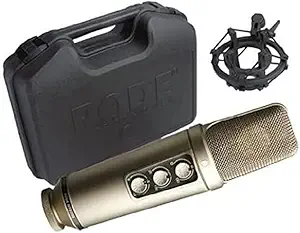


Description
The Rode NT2000 is a large diaphragm condenser microphone built around one idea: continuous adjustment instead of switch positions. Where most multi pattern condensers give you three fixed polar patterns and a two position pad, the NT2000 puts variable controls on the microphone body for polar pattern, pad and high-pass filter, each sweeping smoothly across its range. Rode describes it as a studio workhorse, and the listing dates it to October 2005, which makes it a long running design rather than a current release.
What the NT2000 Is, and Who It Suits
This is a side address studio condenser with a gold-sputtered dual 1 inch capsule. Rode quotes self-noise of 7 dBA, a maximum sound pressure level of 147 dB rising to as much as 157 dB with the pad fully engaged, a frequency range of 20 Hz to 20 kHz, an output impedance of 200 ohms and a signal to noise ratio of 78 dB. Listed weight is 1.83 pounds and the microphone is supplied in silver.
Those numbers describe a microphone for recording rather than for calls. A 7 dBA self-noise figure is low enough to matter on quiet sources such as fingerpicked guitar or spoken word at a distance, where the noise floor of the microphone itself becomes audible in the mix. A 147 dB maximum SPL means loud sources are within its range too. The people this suits are home studio owners, podcasters who record properly rather than over a headset, voice artists, and anyone recording acoustic instruments where the ability to reshape the pickup pattern without swapping microphones saves real time.
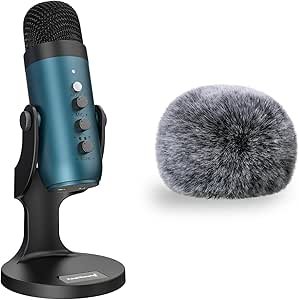
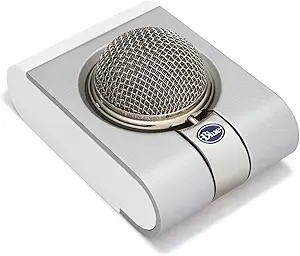
It is worth being clear about what it is not. This is not a plug and play desktop microphone. It has an XLR output and needs an audio interface or a mixing preamp on the other end. If a USB connection is what you actually want, a device such as the ZealSound K66 USB microphone or the compact Blue Snowflake is the right category of product, and neither requires an interface.
The Variable Controls
Polar pattern
Rode’s headline feature is a polar pattern control that sweeps continuously from omnidirectional, through cardioid, to figure-8. Omnidirectional picks up evenly from all directions and is useful for room sound or for a group around one microphone. Cardioid rejects the rear and is the default for a single source in an untreated room. Figure-8 picks up front and rear while rejecting the sides, which is the pattern used for two people facing each other and for certain stereo techniques.
Continuous adjustment between those positions is more useful than it sounds. The intermediate settings between omnidirectional and cardioid, sometimes called wide cardioid or subcardioid, give a natural sounding compromise between room ambience and isolation that a three position switch cannot reach. Being able to dial in a slightly tighter or looser pattern while listening is a practical way to manage a room that is not acoustically treated.
Pad and filter
The pad is listed as continuously variable from 0 to -10 dB, and the high-pass filter as continuously variable from 20 Hz to 150 Hz. Again, the value is in the intermediate settings. A fixed 80 Hz high-pass either removes too much low end on a male voice or leaves too much rumble in; a sweepable filter lets you set it exactly where the problem sits. Rode notes that engaging the pad fully raises the maximum SPL figure from 147 dB to as much as 157 dB.
Highlights
- Continuously variable polar pattern from omnidirectional through cardioid to figure-8.
- Continuously variable pad, listed as 0 to -10 dB, and a sweepable high-pass filter from 20 Hz to 150 Hz.
- Gold-sputtered dual 1 inch capsule with surface mount electronics Rode describes as audiophile quality.
- Quoted self-noise of 7 dBA and a signal to noise ratio of 78 dB.
- Maximum SPL of 147 dB, listed as up to 157 dB with the pad fully engaged.
- Quoted frequency range of 20 Hz to 20 kHz and a 200 ohm output impedance.
- Listed weight of 1.83 pounds, supplied in a silver finish.
Things To Consider
The most important gap in this listing is what comes in the box and what the microphone needs to run. The specification block lists the microphone form factor as “Microphone Only” and the power source as “Corded Electric”, and gives no information about a shock mount, a case, a cable or a power supply. Condenser microphones need power delivered over the XLR cable, and this listing does not state the voltage requirement or whether any external supply is included. Before ordering, confirm two things: that your interface or preamp can supply phantom power to a condenser microphone, and what accessories are actually in the box from the seller you are buying from. A shock mount and a pop filter are usually necessary purchases for vocal work whether or not they are included.
The imported specification block contradicts itself and the physical product in a few places. Material is listed as “Plastic”, which does not describe a metal bodied studio condenser of this class. Frequency response is given as “20 KHz” in one field while frequency range is given correctly as 20 Hz to 20 kHz in another, so the single number field should be ignored. Product dimensions of 16 x 6 x 13 inches describe packaging, not the microphone. Note also that this page lists a warranty type of Limited and does not state a term, so any longer warranty coverage Rode offers should be confirmed with the manufacturer at the time of purchase rather than assumed from this listing.
Practically, a microphone this sensitive amplifies room problems. A 7 dBA noise floor is wasted in a room with a computer fan, traffic outside or a bare ceiling. Budget for acoustic treatment, or at least for recording in the quietest space available, before spending on a microphone at this level. Monitoring matters too, since variable controls are only useful if you can hear what changing them does; a pair of near field speakers such as the KEF Ci160ER or closed back headphones is part of the same purchase decision.
Who Should Buy It, and Who Should Not
Buy the NT2000 if you already run an audio interface with phantom power, you record varied sources, and you want to shape the pickup pattern and filtering at the microphone rather than fixing it later in software. The continuous controls are the reason to choose this over a switched multi pattern condenser, and the low self-noise figure makes it credible on quiet material.
Do not buy it if you want a single cable connection to a PC, if you have no interface and no plans to buy one, or if your recording space is noisy enough that the microphone’s own noise floor is irrelevant. Gaming and streaming buyers in particular are usually better served elsewhere: a headset mounted microphone such as the Astro A40 TR microphone is designed for a different job entirely. Our computer microphones category covers both ends of that range.