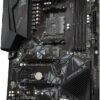
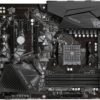
Description
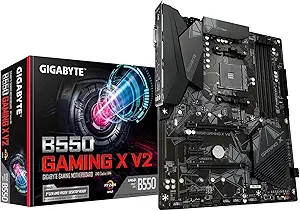
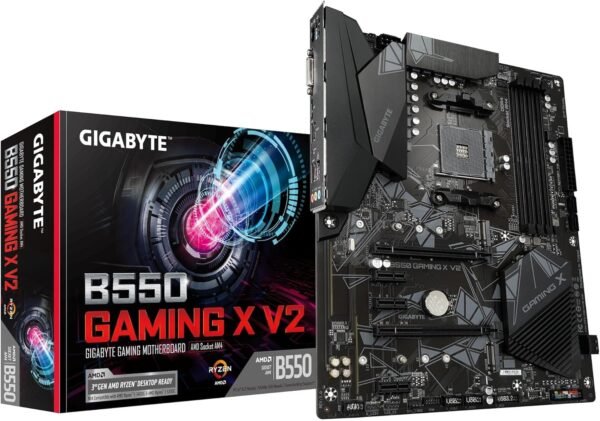
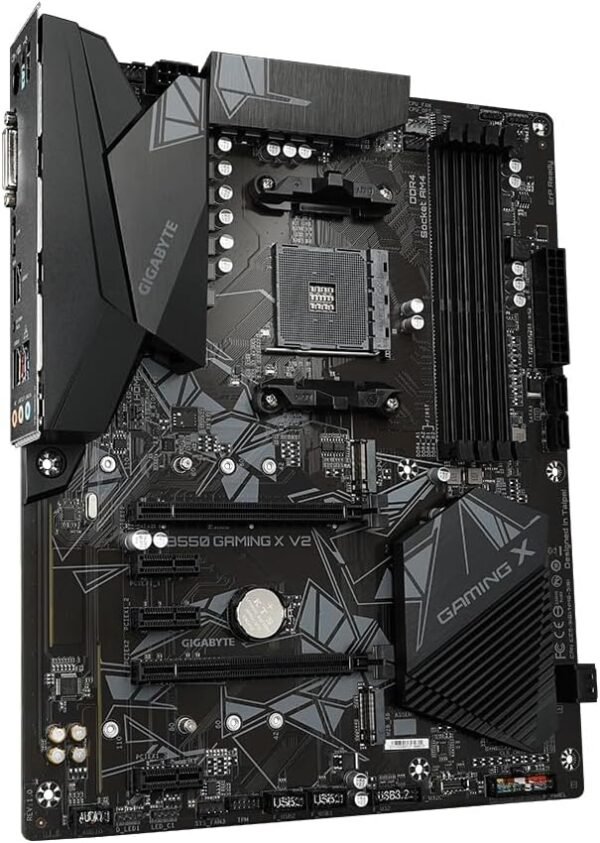
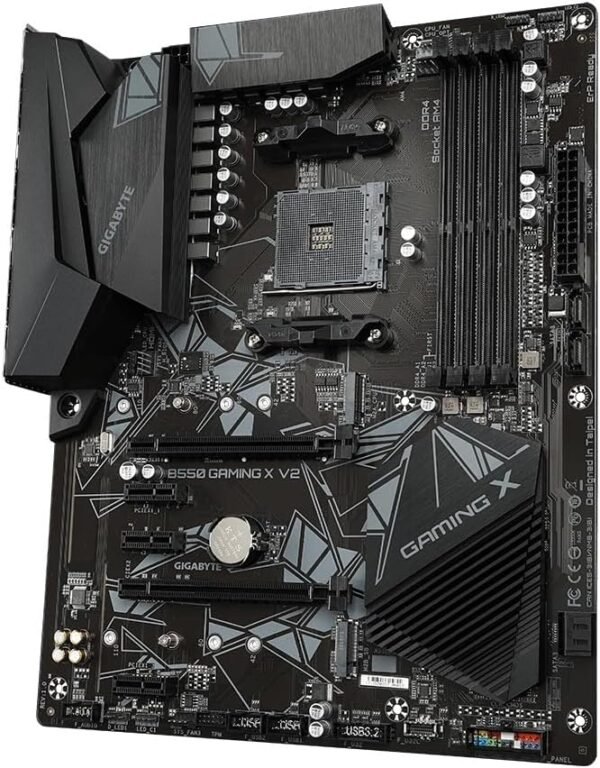
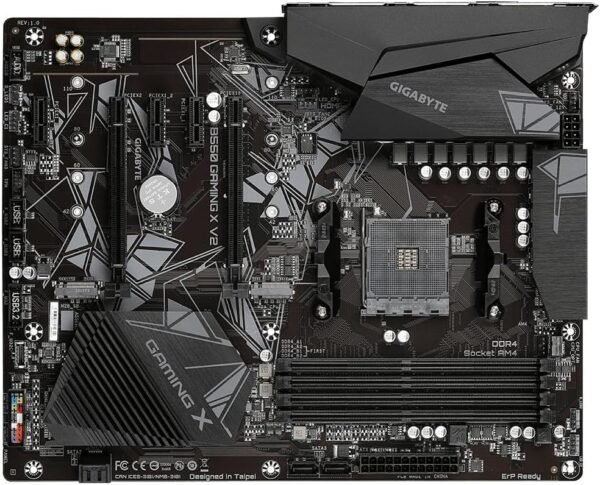
The GIGABYTE B550 Gaming X V2 is an ATX motherboard on socket AM4 using the AMD B550 chipset. It takes DDR4 memory across four DIMM slots, supports PCIe 4.0, and carries two M.2 slots. GIGABYTE lists processor support for Ryzen 5000, Ryzen 4000 and Ryzen 3000 series parts, which is a broader and more current list than many B550 listings provide.
Compatibility in short: socket AM4, chipset B550, form factor ATX, memory DDR4. Builders comparing similar boards can look at the ASRock B550M Steel Legend, the ASUS TUF Gaming B550M-PLUS or the older GIGABYTE B450M-DS3H.
Processor Support And BIOS Updating
GIGABYTE states the board is ready to support AMD Ryzen 5000, Ryzen 4000 and Ryzen 3000 series processors. That covers the most desirable AM4 processors, including the 5000 series that many builders target for a final AM4 upgrade.
Crucially, GIGABYTE also lists Q-Flash Plus, described as upgrading the BIOS without installing a CPU, memory or graphics card. That combination matters more than it looks. A board that claims Ryzen 5000 support may still ship with older firmware that does not recognize the processor, and without Q-Flash Plus the buyer would need a compatible older processor just to perform the update. With it, a USB stick and mains power are enough. On an AM4 board bought today for a 5000 series processor, this is the single most useful feature on the list.
The V2 suffix in the model name indicates a revised version of the original Gaming X. GIGABYTE does not explain on this listing what changed between versions, so buyers should confirm they are receiving the V2 revision if that matters to them.
Power Delivery And Cooling
The power design is described as a digital twin 10 plus 3 phase VRM solution with premium chokes and capacitors. Thirteen phases in total on a B550 board is generous provisioning, and it means the board can feed a high core count Ryzen processor without the voltage regulation becoming the limiting factor.
Cooling those phases is handled by enlarged VRM heatsinks layered with 5 W/mK thermal pads. The thermal conductivity figure is a real specification rather than an adjective, and 5 watts per meter kelvin is a reasonable value for a pad transferring heat from the power stages into the heatsink. GIGABYTE also fits a pre installed input and output armor shield, which saves the fiddly step of clipping a separate shield into the case before mounting the board.
Smart Fan 5 provides fan control with multiple temperature sensors and hybrid fan headers with a fan stop function, so case fans can be set to switch off entirely at low temperatures rather than idling.
Storage, Connectivity And A Memory Standard Error
GIGABYTE lists PCIe 4.0 support, two M.2 slots, gigabit Ethernet, USB 3.2 Gen 2 and a USB 3.2 Gen 1 Type-C connection. PCIe 4.0 on B550 applies to the primary graphics slot and the primary M.2 slot, with the chipset providing PCIe 3.0 for the remainder, though this listing does not spell out which slot gets what. Display outputs are HDMI and DVI, which function only with a Ryzen processor that has integrated graphics.
Networking is gigabit Ethernet only, with no 2.5 gigabit port and no onboard wireless mentioned anywhere. Anyone wanting faster wired networking or built in Wi-Fi will need an expansion card such as the TP-Link Archer TX3000E.
There is a clear error in the memory bullet that buyers should not be misled by. GIGABYTE writes that the board is compatible with DDR4 memory and supports four DIMMs with AMD EXPO memory module support. EXPO is AMD’s memory profile standard introduced alongside DDR5 and the AM5 platform. A DDR4 AM4 board uses XMP profiles, often branded DOCP or similar on AMD boards, not EXPO. The mention of EXPO here is boilerplate carried over from a newer product, and a buyer should not expect EXPO profiles to be relevant to any DDR4 kit they buy for this board.
Highlights
- Socket AM4 with the AMD B550 chipset in ATX form factor.
- Supports Ryzen 5000, 4000 and 3000 series processors per GIGABYTE.
- Four DDR4 DIMM slots, with 128GB given as the capacity in the product title.
- PCIe 4.0 support with two M.2 slots.
- Digital twin 10 plus 3 phase VRM with enlarged heatsinks and 5 W/mK pads.
- Gigabit Ethernet, USB 3.2 Gen 2 and USB 3.2 Gen 1 Type-C.
- HDMI and DVI outputs for processors with integrated graphics.
- Q-Flash Plus BIOS updating with no CPU, memory or GPU installed.
- Smart Fan 5 with fan stop and RGB Fusion 2.0 lighting headers.
Things To Consider
The specifications block on this listing is completely empty. Every fact above comes from the product title and nine seller written bullets. There is no weight, no dimensions, no rear port list, no SATA port count, no PCIe slot layout, no fan header count and no memory speed rating anywhere in the structured data.
There is also no customer rating and no review count on the record at all. For a motherboard, which is the component a whole build depends on, the absence of both specifications and peer feedback is a genuine gap. GIGABYTE publishes full details on its own product page and buyers should work from there.
The platform itself is mature rather than current. AM4 has been succeeded by AM5, so a build on this board is a build on a completed platform: the processors available are the ones that already exist, and there will be no future generation to upgrade into. That is not automatically a disadvantage, since AM4 processors are widely available and B550 supports PCIe 4.0, but it should be a deliberate choice rather than an accident.
Gigabit networking is the other dated element. A board sold today with a single gigabit port limits file transfer speed to a network attached storage device or between machines. Readers can compare alternatives in the motherboards category and processors in the CPU processors category.
Who It Suits
The B550 Gaming X V2 suits a builder assembling a value focused AMD system around a Ryzen 5000 processor, who wants PCIe 4.0, two M.2 drives and four memory slots without paying for a premium board. Q-Flash Plus makes it a safe choice specifically because a firmware mismatch cannot strand the build.
It is the wrong board for anyone who wants onboard Wi-Fi or faster than gigabit Ethernet, for builders planning a long upgrade path, since AM4 has ended, and for buyers who need the port and slot layout documented before ordering. Anyone who wants a body of customer feedback to lean on will not find it on this listing.