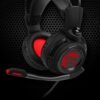
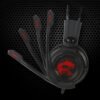
Description
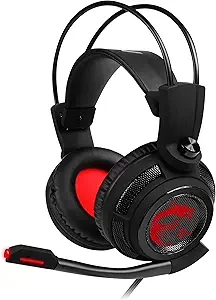
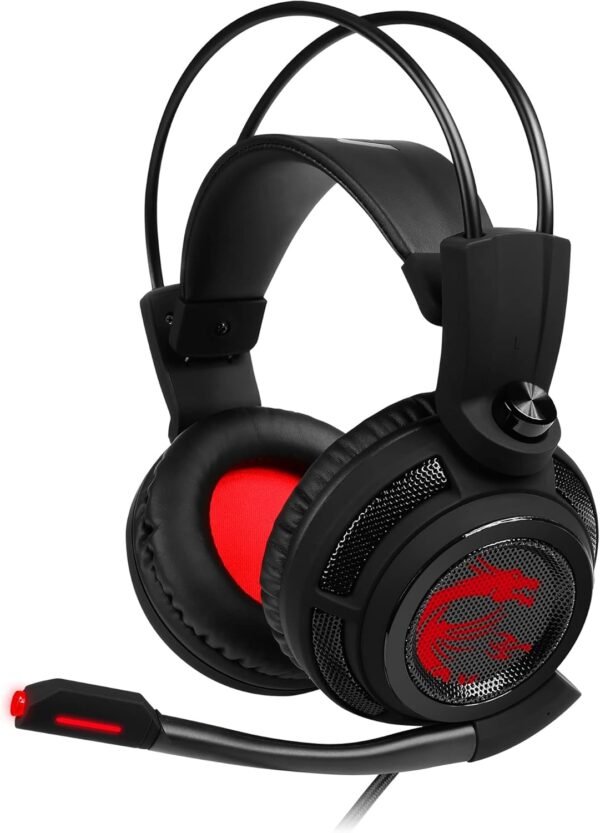
The MSI DS502 is a wired gaming headset that connects over USB rather than a 3.5 mm jack, with software driven virtual 7.1 surround and a vibration feedback feature MSI calls intelligent rumble. It is an older product, first listed in January 2019, and it sits at the budget end of the gaming headset market where the feature list is long and the individual components are ordinary.
The USB only connection is the single most important thing to check before buying. It rules out any device that needs an analog plug, including most controllers and phones. Buyers who need analog compatibility should look at the Sony INZONE H3 or the SteelSeries Siberia v2, and those who want wireless should compare the Logitech G435.
Drivers, Sound And The Open Back Design
MSI fits dual 40 mm neodymium dynamic drivers with an impedance of 32 ohms and quotes a frequency range of 20 Hz to 20,000 Hz with a sensitivity of 105 dB. Those are ordinary and appropriate figures for a USB headset, where the amplifier is built into the connector rather than being supplied by the host device.
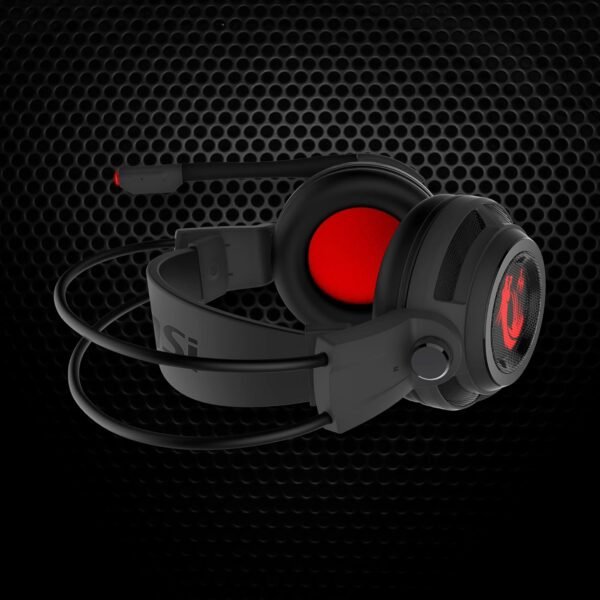
The open back design deserves more attention than the listing gives it. Open back headphones let air and sound pass through the rear of the earcup, which typically widens the sense of space in the audio and reduces the pressure sensation of sealed cups. It also means sound leaks out to people nearby and outside noise leaks in. This is a genuine trade off, not a flaw, but anyone gaming in a shared room or an office should know that an open back headset is audible to others and offers little isolation. The specification field Noise Control on this listing reads None, which is consistent with an open back design.
Virtual Surround And The Xear Software
The 7.1 surround here is software driven, and MSI is honest about that, describing it as software enhanced virtual 7.1 rather than implying multiple physical drivers per ear. Processing is handled by Xear Technology from C-Media, which unlocks virtual surround controls, adjustable environmental reverb and a 10 band equalizer.
A 10 band equalizer is more control than most gaming headsets expose, and for a listener willing to spend time tuning it that is a real feature. The reliance on C-Media software also creates a dependency: the surround processing and the equalizer only exist while that software is installed and functioning, and on a console the headset falls back to plain stereo. Buyers should treat the surround as a PC and Mac feature.
Rumble, Microphone And Controls
The vibration feedback is the most polarizing feature on this headset. Motors in the earcups pulse in response to low frequency audio, which some players find adds impact to explosions and engine noise and others find distracting. MSI puts the on and off switch on the inline control, which is the right decision, since it means the feature can be disabled without opening software.
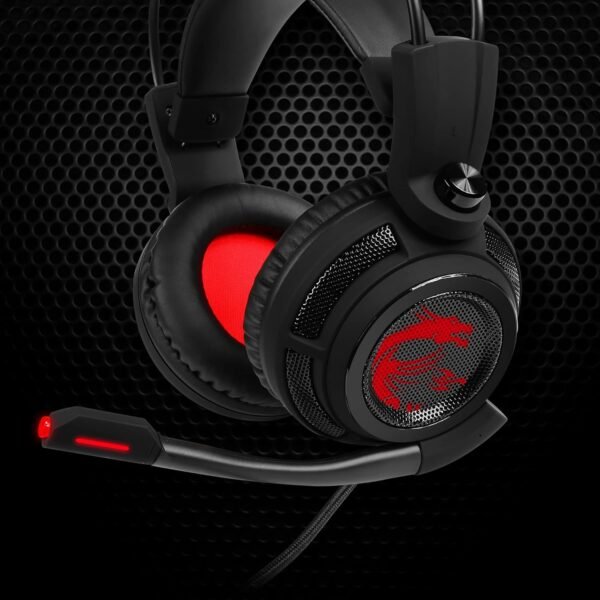
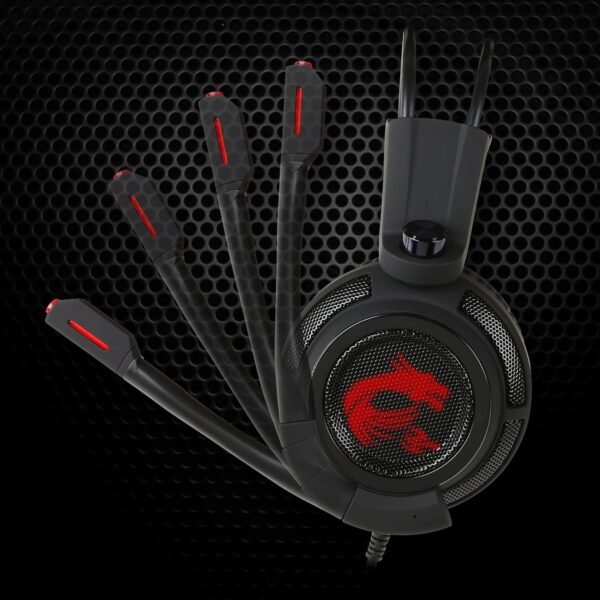
The microphone is an adjustable omnidirectional boom with a red LED that indicates when it is active. Omnidirectional means it picks up sound from all directions rather than focusing on the mouth, which typically captures more room noise than a unidirectional or noise canceling microphone would. For casual voice chat that is acceptable, and for streaming or recording a dedicated microphone such as the Blue Snowflake USB microphone will be a substantial step up.
Inline controls cover volume, the microphone switch and the vibration toggle. The cable is described as a 2 meter low resistance braided cable terminating in a USB 2.0 connector, and the whole headset weighs 14.3 ounces, which is on the heavy side for extended sessions. The headband is self adjusting, so there is no manual size adjustment to set.
Highlights
- Dual 40 mm neodymium drivers at 32 ohms, 20 Hz to 20,000 Hz, 105 dB sensitivity.
- Software driven virtual 7.1 surround through Xear Technology by C-Media.
- 10 band equalizer plus environmental reverb settings.
- Rumble feedback switchable from the inline control.
- Adjustable omnidirectional microphone with an active indicator LED.
- Inline volume, microphone and vibration controls.
- 2 meter braided cable with a USB 2.0 connector.
- Listed compatibility with PC, Mac, PS5 and PS4.
Things To Consider
The specification block contradicts itself and the product description repeatedly. Wireless Communication Technology reads Mini Stereo Headphone Jack (3.5mm) on a headset the same listing describes as USB wired with no analog option. The Batteries field reads one lithium ion battery required, on a headset powered entirely by the USB cable. Control Method reads App while Controller Type correctly reads inline controls and USB connector. Control Type reads Noise Control while the Noise Control field itself reads None. Cable Feature reads Detachable, though the description simply refers to a 2 meter cable without saying it detaches. Frequency Response is given as a single value of 20000 Hz while Frequency Range correctly gives 20 Hz to 20,000 Hz.
The practical limitations are the weight, the open back design and the USB dependency. At 14.3 ounces this is a heavy headset by current standards, and weight is the main driver of fatigue over a long session. The open back leaks sound in both directions. And a USB only connection means no Xbox, no Nintendo Switch in handheld mode and no phone.
Customer feedback is reasonable at 4.4 stars across 443 ratings, which is a decent sample for a budget headset and the most reliable figure on the listing. MSI has kept it on sale since 2019 and lists it as not discontinued. Readers comparing options can browse the headsets category or the office focused computer headsets category.
Who It Suits
The DS502 suits a PC or PlayStation gamer on a budget who plays in a private room, wants virtual surround and a configurable equalizer without paying for a premium headset, and is curious about rumble feedback. The inline controls and the self adjusting headband both make it easy to live with day to day.
It is the wrong headset for Xbox or Switch users, for anyone who needs a 3.5 mm connection, for shared spaces where an open back design will annoy others, for streamers who need a clean microphone, and for anyone sensitive to headset weight over long sessions.