Description
What The Milwaukee 2891-20 Is
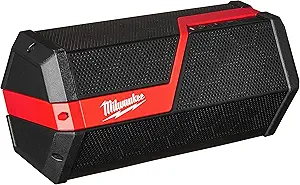
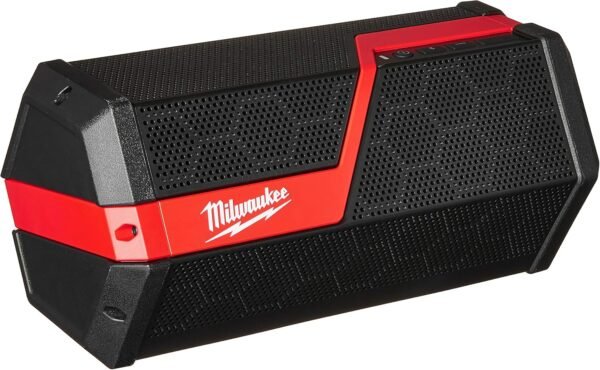
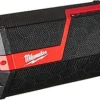
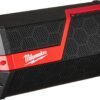
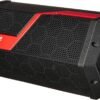
The Milwaukee 2891-20 is a jobsite Bluetooth speaker, and it is worth saying up front that this is a construction tool accessory rather than a computer peripheral. It belongs to the Milwaukee M18 power tool platform and is designed to run from the same batteries that power a drill or a saw. It appears in this catalog under portable Bluetooth speakers, and it is a legitimate product in that category, but anyone shopping for desk or home audio should know they are looking at a tool.
Milwaukee describes it as streaming audio wirelessly from any Bluetooth device, connecting up to 100 feet away, with an auxiliary connection available as an alternative. The design priorities are volume and survival rather than fidelity, which is the correct set of priorities for a speaker that lives in the back of a truck. Someone who wants a rugged speaker for outdoor use without buying into a power tool battery system would be better served by the Altec Lansing Super LifeJacket Jolt or the Monster Adventurer Max.
Drivers And Amplification
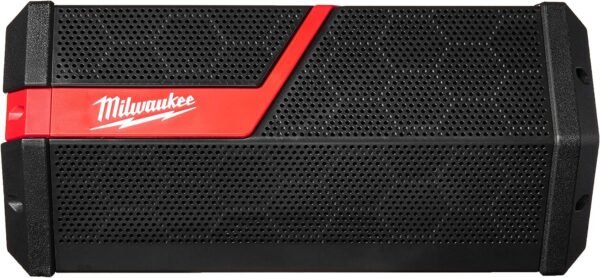
The driver arrangement is described in detail. Two high definition mid woofers are fitted to maximize clarity at high volume, two high range tweeters handle treble, and two passive radiators are used to increase bass output and volume. A 40 watt digital amplifier drives the system, and Milwaukee describes the result as stereo quality sound with the loudest volume and lowest distortion in its wording.
Passive radiators are worth understanding because they explain how a box this size produces usable bass. A passive radiator is an undriven diaphragm that moves with air pressure inside the cabinet, extending low frequency output without the cabinet volume a larger driver would need. It is a common approach in rugged portable speakers and it is a sensible one here, where cabinet space is taken up by a roll cage and a battery bay.
Power Options
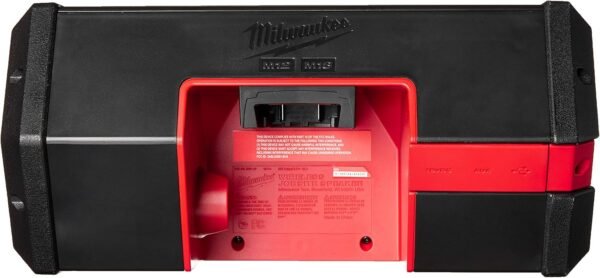
The speaker runs from Milwaukee M18 or M12 batteries or from an AC outlet, which is the feature that decides whether this product makes sense for a given buyer. If you already own M18 tools, the batteries are on the shelf and the speaker costs nothing extra to run. If you do not, the listing data indicates batteries are not included, so a battery and a charger become part of the purchase and change the total cost substantially. A USB power outlet on the speaker charges a phone or other device in both AC and battery modes.
Durability And Build
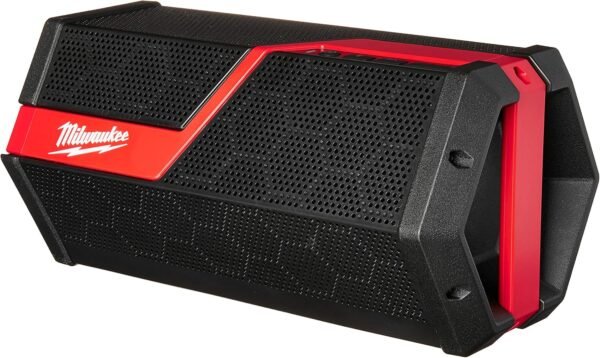
Construction is the other half of the pitch. Milwaukee lists heavy duty construction with water and dust protection, an impact resistant roll cage, and reinforced side caps and grill to improve impact resistance. The specification table marks the unit as waterproof.
That claim deserves a caveat rather than repetition. The listing gives no IP rating anywhere, and waterproof without an ingress protection figure is a marketing word rather than a specification. The honest reading is that the speaker is built to survive site conditions including rain and dust, and that the exact level of protection is not documented on this page. Buyers who need a stated rating should check Milwaukee’s own documentation for the 2891-20.
Controls are listed as remote and touch in the specification table, though the description does not detail a control layout, so the exact button and dial arrangement is not documented on this page. Milwaukee also does not publish an equalizer or app control feature here, which fits the product type: a site speaker is expected to be operated with gloves on rather than through a phone. For anyone weighing this against a consumer alternative, the SOWO waterproof Bluetooth speaker covers outdoor use without a tool battery system.
Highlights
- Runs from Milwaukee M18 or M12 batteries or from AC power.
- Two mid woofers, two tweeters and two passive radiators.
- 40 watt digital amplifier.
- Bluetooth range quoted at up to 100 feet.
- Auxiliary input for wired sources.
- USB power outlet for charging devices.
- Impact resistant roll cage with reinforced side caps and grill.
- Water and dust protection for site use.
Things To Consider
The specification data on this listing is unusually contradictory and should be treated with care. The physical size is given three different ways: the description says 7.5 inches long by 13.75 inches wide by 6.5 inches high, the product dimensions field says 14 by 16 by 16 inches, and a separate Size field says 15.20 by 7.85 by 6.80. Weight is given as 5.3 pounds in the description and 6.34 pounds in the specification table. The Style field reads Hammerdrill, the Included Components field reads Multitool Accessory, and Batteries Required is marked No on a speaker the description says is powered by M18 or M12 batteries. A subwoofer diameter of 6.5 inches is listed even though the description names two mid woofers and two passive radiators rather than a subwoofer, and a battery life of 3 hours appears with no indication of which battery capacity it refers to.
- This is a power tool accessory. It is not a desk or home audio product.
- Batteries and a charger are not included, which changes the real cost for anyone outside the M18 system.
- No IP rating is published, so the waterproof claim is undocumented.
- Battery life is listed as 3 hours without stating the battery capacity assumed.
- Size and weight are each stated in multiple conflicting ways.
- The Style and Included Components fields describe unrelated tools.
- Sound tuning is aimed at volume in open air, not at accuracy.
Who Should Buy It And Who Should Not
This speaker makes sense for one buyer above all others: someone already invested in Milwaukee M18 or M12 tools who wants site audio that shares the same batteries and survives being knocked around. The roll cage, the USB charging outlet and the AC option make it a practical piece of site equipment, and the 100 foot Bluetooth range covers a work area rather than a room.
It is the wrong purchase for anyone who does not own Milwaukee batteries, for indoor listening where fidelity matters, and for anyone comparing it against consumer speakers on sound quality alone. Those buyers should look at the JBL Charge 5, the Marshall Stockwell II or the rest of the portable Bluetooth speakers category, all of which include their own batteries.