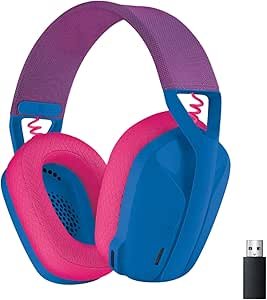


Description
The Logitech G435 is a wireless gaming headset built around low weight and dual connectivity. Logitech specifies LIGHTSPEED wireless alongside Bluetooth, built-in microphones rather than a boom arm, 18 hours of battery life, and compatibility with Dolby Atmos. It is listed for PC and mobile use, and the version here is blue.
This listing carries no specification block and no description text beyond the product title, so driver size, weight in grams, frequency response, charging time and the full compatibility list are all unstated. This review works from the title and identifies what is missing.
Two Wireless Systems, and Why Both
The G435 offers LIGHTSPEED and Bluetooth, and the distinction between them is the most useful thing to understand about this headset.
LIGHTSPEED is Logitech’s proprietary 2.4 GHz wireless, delivered through a small USB receiver. It is designed for low latency, which matters in games where audio cues arrive fractionally before you react to them. Bluetooth, by contrast, introduces more latency and is not ideal for competitive play, but it needs no receiver and no free USB port, which is what makes it work with phones, tablets and laptops that have no port to spare.
Having both means one headset covers a desk PC and a phone without compromise on either. The practical questions the listing does not answer are whether both connections can be active at once, so that a phone call interrupts game audio, and how you switch between them. Ask, or check Logitech’s documentation, if that behavior matters.
Note also what the listing names for platform support: PC and mobile. Consoles are not named. A headset with a USB receiver will often work with a console that supports USB audio, but this listing does not claim it and this review will not either. If console use is your requirement, a headset that states it, such as the Razer Barracuda X, is the safer purchase.
The Microphone Arrangement
The G435 uses built-in microphones rather than a boom arm, and this is a genuine design decision with real consequences in both directions.
In favor: nothing sticks out from the earcup, so the headset looks like ordinary headphones and can be worn outside without attracting attention. There is no boom to snap, no boom to knock against a desk, and no boom to fold away. For a headset used across gaming and commuting, that is a meaningful convenience.
Against: a microphone built into the earcup sits further from your mouth than a boom, and distance is the single biggest factor in voice quality. Built-in microphone arrays use beamforming and processing to compensate, and they do a reasonable job in a quiet room. In a noisy one, or where voice quality is genuinely important, a boom is better and a standalone microphone is better still. If you stream or record, a separate microphone such as the Blue Snowflake is the right tool and the headset becomes purely a listening device.
Weight, Battery and Audio
Logitech leads with lightweight in the product title, and headset weight is the specification that determines comfort over a long session more than any other. Unfortunately this listing gives no weight figure. What can be said is that Logitech has positioned the G435 as its light model and that the design, with no boom arm and no heavy hinge mechanism, is consistent with that.
Battery life is quoted at 18 hours. That is enough for several days of evening use between charges. The listing does not state charging time, the charging connector, or whether the headset can be used while charging.
Dolby Atmos compatibility is listed. Atmos for headphones is a spatial audio system that processes stereo output into positional audio, and on Windows it is a licensed feature. The listing does not state whether a license is included with the headset or must be purchased separately, so do not assume Atmos is available at no cost. The headset works as a normal stereo device regardless.
Highlights
- Logitech LIGHTSPEED 2.4 GHz wireless with a USB receiver for low latency.
- Bluetooth wireless for phones, tablets and laptops without a spare port.
- Built-in microphones with no protruding boom arm.
- Quoted battery life of 18 hours.
- Lightweight over-ear design, Logitech’s stated priority for this model.
- Listed as compatible with Dolby Atmos spatial audio.
- Listed for PC and mobile use, in a blue finish.
Things To Consider
The listing gives no specification block at all, which leaves these unanswered: driver size, frequency response, headset weight, clamping force, ear cushion material, charging time and connector, whether volume controls sit on the earcup, whether a carrying case or extra cable is included, and the exact list of supported platforms.
Two of those matter more than the rest. Weight, because it is the stated selling point and no number is given. And ear cushion material, because on a lightweight headset the cushions are usually fabric or thin foam rather than the thicker leatherette used on heavier models, and that changes both comfort and passive isolation. Fabric cushions run cooler and isolate less; leatherette does the opposite. Neither is better, but they suit different rooms.
A third practical point: built-in microphones cannot be muted by flipping a boom up, which is the most convenient mute gesture in gaming headsets. Confirm how muting works before buying if you use it constantly.
Finally, note that a headset with two wireless systems and no wired option is entirely dependent on its battery. There is no analog fallback described here, so when it runs flat you are done until it charges. Wired headsets such as the Sony INZONE H3 never have that problem, which is the trade wireless always makes.
Who Should Buy It, and Who Should Not
Buy the G435 if you want one wireless headset for a PC and a phone, low weight matters to you, and you prefer a design without a boom microphone sticking out. The dual wireless arrangement is genuinely useful, 18 hours covers a week of normal use, and the absence of a boom makes it usable outside the house without looking like gaming equipment.
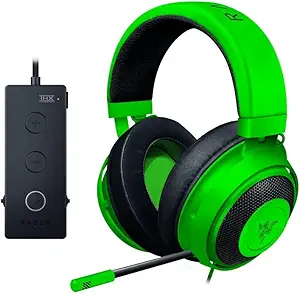
Do not buy it if voice quality is critical, if you play on a console and need stated compatibility, or if you want documented specifications before purchase. Wired alternatives with published detail include the Razer Kraken Tournament Edition, and for a lightweight wireless alternative the ROCCAT Syn Pro Air is worth comparing. Our headsets category covers gaming models and the computer headsets category covers office focused ones.