


Description
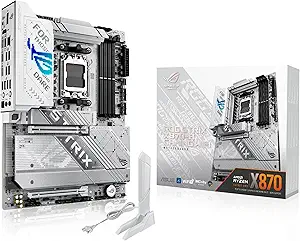
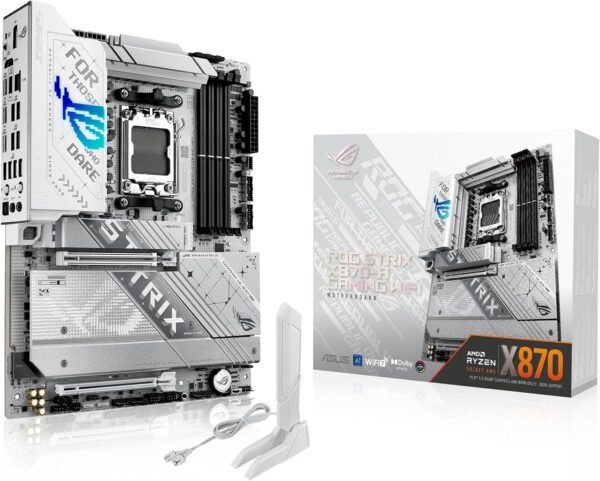
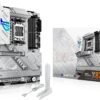
The ASUS ROG Strix X870-A Gaming WiFi is a full size ATX motherboard for AMD’s AM5 socket, built on the X870 chipset and finished in white. It is a high specification board: ASUS lists 16+2+2 power stages, DDR5 memory support with AEMP profiles, PCIe 5.0, four M.2 slots, WiFi 7 and USB4, along with the company’s Dynamic OC Switcher, Core Flex and Q-Release Slim features. The listing dates it to September 2024.
Compatibility First
On a motherboard, compatibility comes before everything else, so here is what the listing actually states and what it does not.
Stated: the socket is AMD AM5. The chipset is X870. The form factor is ATX. The memory type is DDR5. PCIe 5.0 is supported. ASUS’s description explicitly names support for AMD Ryzen 9000 Series processors.
Not stated: the listing does not enumerate support for earlier AM5 generations, and it does not mention BIOS versions or firmware requirements anywhere. If you intend to pair this board with a processor other than a Ryzen 9000 Series part, look the exact model up on ASUS’s own CPU support list for this board and note which BIOS revision is required. That list is the authority, not the product title. Similarly, the listing does not state a maximum supported memory capacity or a validated memory speed, so match your memory kit against the board’s qualified vendor list rather than against a general DDR5 speed claim.
The ATX form factor is worth confirming against your case. This is a full size board, not a compact one, and a case built for Micro ATX will not take it. If a smaller build is what you want, the GIGABYTE X870I AORUS PRO ICE covers the same chipset generation in an ITX size, and the GIGABYTE B650M AORUS Elite AX is the Micro ATX alternative on the earlier chipset.
Power Delivery and Overclocking Features
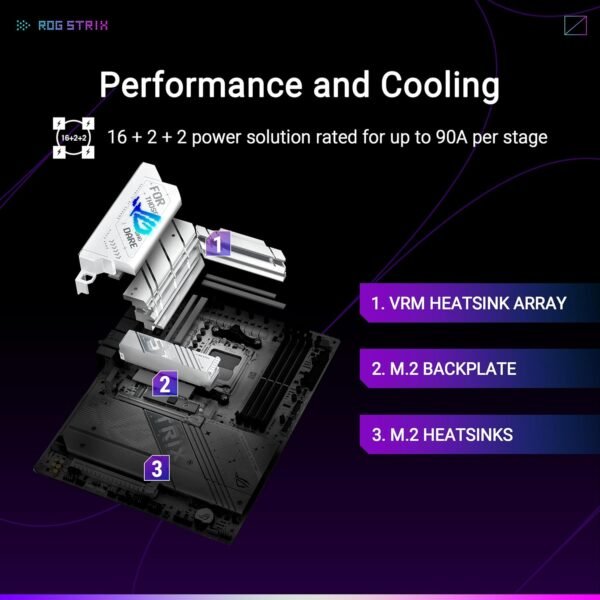
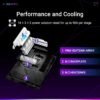
16+2+2 power stages
The 16+2+2 notation describes how the board’s voltage regulation is divided: sixteen stages for the processor cores, two for the SoC portion of the chip, and two more for auxiliary rails. More stages spread the current and the heat across more components, which is what allows a board to hold voltage steady under sustained multi core load rather than sagging or throttling. Sixteen core stages is a substantial arrangement and is one of the concrete reasons a board sits in this tier rather than the entry tier.
ASUS overclocking features
Dynamic OC Switcher is ASUS’s mechanism for switching between two overclocking behaviors depending on load, so a system can favor single core frequency for lightly threaded work and switch to an all core profile for heavy work. Core Flex is listed alongside it, and ASUS also lists AI Overclocking and AI Networking features. Those names describe automation of tuning that an experienced builder would otherwise do by hand. The listing does not quantify what any of them achieve, and no performance figure is claimed here. Anyone planning serious overclocking on a Ryzen 9000 Series part will also need cooling to match, which puts a 360 mm unit such as the TRYX Panorama 360 in the same conversation.
Connectivity and Storage
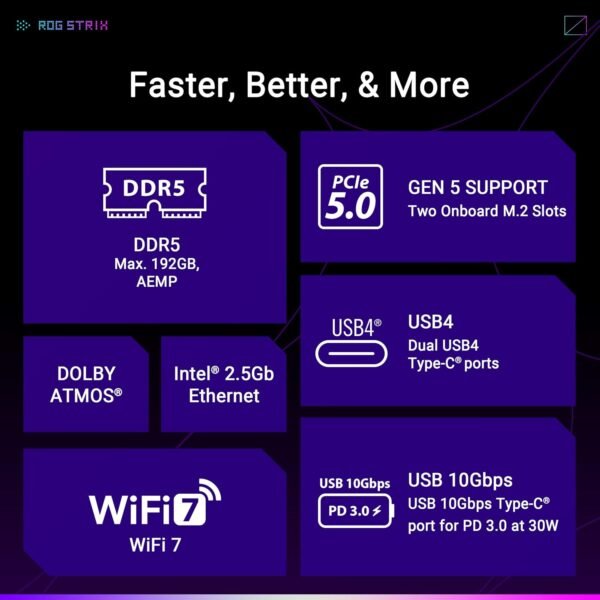
Four M.2 slots is a lot for a consumer board and is the specification most likely to matter over the life of the machine. It allows a boot drive plus three additional NVMe drives without touching SATA. What the listing does not describe is how the lanes are allocated: on most boards, populating certain M.2 slots disables SATA ports or reduces the bandwidth of the primary graphics slot. That allocation table lives in the manual, and it is worth reading before planning a four drive build.
PCIe 5.0 is listed. The generation matters for the primary graphics slot and, on boards that route it that way, for at least one M.2 slot. USB4 is listed as well, which brings a high bandwidth USB-C connector suitable for external drives and displays. On networking, WiFi 7 is stated. WiFi 7 requires a WiFi 7 router to deliver its advantages; on an older access point the board falls back to earlier standards, so the wireless specification is only half of an upgrade. Q-Release Slim is ASUS’s mechanism for removing a graphics card without reaching for the retention clip, which is a small feature that becomes a large one when a heavy triple slot card sits over the latch.
Highlights
- AMD AM5 socket, X870 chipset, ATX form factor, Silver White finish.
- 16+2+2 power stages for processor and SoC voltage delivery.
- DDR5 memory support with ASUS AEMP profiles.
- PCIe 5.0 support and four M.2 storage slots.
- WiFi 7 wireless and USB4 connectivity.
- Dynamic OC Switcher, Core Flex, AI Overclocking and AI Networking features.
- Q-Release Slim mechanism for graphics card removal.
- Explicitly listed support for AMD Ryzen 9000 Series processors.
Things To Consider
The imported specification block on this page is unreliable and should not be used for any purchasing decision. Three entries in particular are wrong:
- Chipset Brand reads “NVIDIA”. This is an AMD X870 board. NVIDIA does not make AM5 chipsets.
- Memory Speed reads “160 MHz”, which is not a DDR5 speed and is not a meaningful figure for any modern memory.
- Product dimensions of 13.9 x 10.7 x 2.8 inches and a weight of 5.57 pounds describe the retail box, not the board. An ATX motherboard measures 12 x 9.6 inches.
Beyond the data quality, the real considerations are cost and necessity. This is a high tier board, and much of what you pay for sits at the top of the specification sheet: WiFi 7, USB4, PCIe 5.0 and four M.2 slots. If your build uses one drive, a wired network connection and a graphics card that does not saturate PCIe 4.0, most of that goes unused. Chipset choice is where the money is decided, and a lower tier chipset on the same socket delivers the same processor support with fewer high speed connections.
Note also that a board this size and this heavily equipped needs a case with the depth for a full ATX layout, adequate rear panel clearance, and a power supply with the connectors a high stage design and a modern graphics card expect. Check the power supply requirement for your intended processor and graphics card together rather than for the board alone.
Who Should Buy It, and Who Should Not
Buy the ROG Strix X870-A Gaming WiFi if you are building a current AM5 system around a Ryzen 9000 Series processor, you want four M.2 slots and USB4 rather than discovering later that you needed them, and the white finish fits the build you have in mind. The power delivery arrangement and the overclocking features make it a sensible platform for a processor you intend to push.
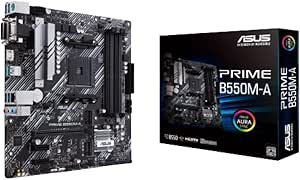
Do not buy it if you have an AM4 processor, since AM5 is a different socket and the two are not interchangeable; the ASUS Prime B550M-A WiFi II is the AM4 equivalent in that case. Do not buy it if your build has modest storage and networking needs, where a lower tier chipset saves money for no functional loss. And if you are still choosing a processor, the AMD Ryzen 5 7600X is the other half of that decision. Our motherboards category covers the range across both sockets.