


Description
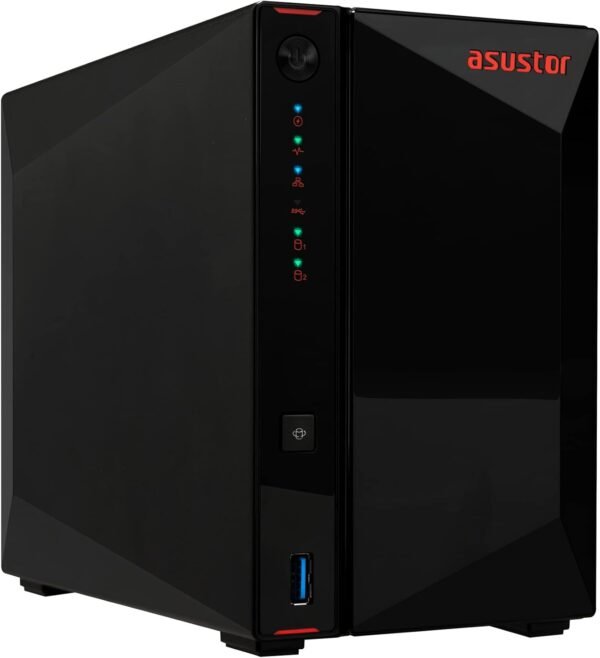
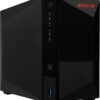
The Asustor AS5402T is a compact network attached storage unit with an unusual configuration: two conventional drive bays and four M.2 NVMe slots. Most two bay units have no M.2 slots at all, and most units with four M.2 slots are far larger, so this is a genuinely distinctive design and the main reason to consider it.
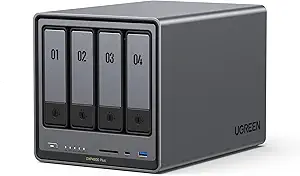
Buyers comparing NAS options should look at the Synology DS923+ for a four bay desktop alternative, the UGREEN NASync DXP4800 Plus for a similar hybrid approach, and the rackmount Synology RackStation RS1221+ if a rack is available.
The Storage Layout And Why It Matters
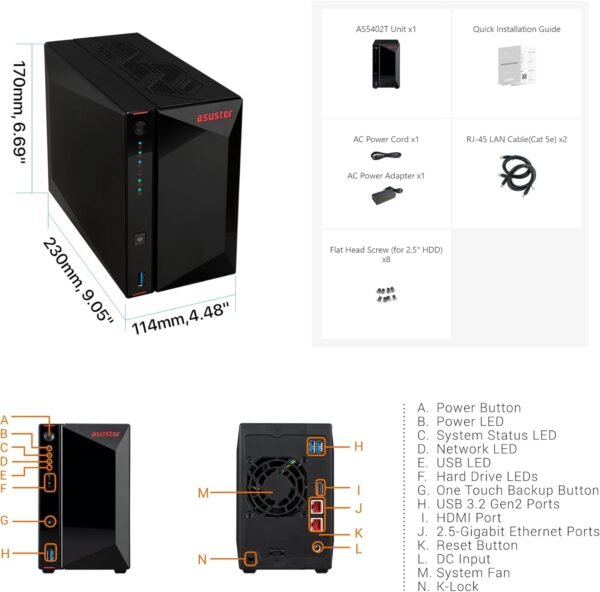
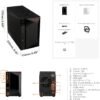
Six drive positions in a unit measuring 9.06 by 4.49 by 6.69 inches is dense. The two conventional bays take standard drives for bulk capacity, and the four M.2 slots take NVMe solid state drives on a PCIe x4 interface for speed.
That opens two useful configurations. The first is tiered storage: fast NVMe drives holding active project files and working data, with the two mechanical bays providing large capacity for archives and backups. The second is an all flash setup using only the M.2 slots, which produces a silent, low power NAS with no moving parts, though at a higher cost per terabyte.
Asustor also lists what it describes as thermal vents for M.2 SSD heat dissipation. That is worth having rather than decorative, because NVMe drives packed four to a small chassis generate real heat and thermal throttling under sustained transfers is a common problem in compact enclosures.
The unit ships diskless. None of the six positions is populated, so the drives are an entirely separate purchase and a substantial one if all six are filled.
Processor, Memory And Networking
The processor is an Intel Celeron N5105, a quad core part on a 10 nm process, listed at 2.0 GHz. That is an entry level chip by desktop standards and appropriate for a NAS, where the workload is file serving rather than computation. It has enough capability for media transcoding in some formats and for running containerized applications, though the listing makes no transcoding claims and buyers who need that should verify supported codecs directly with Asustor.
Memory is 4GB of DDR4-2933. The listing does not state whether that is soldered or in a slot, and does not state the maximum supported capacity. Memory is the most common upgrade on a NAS, particularly for anyone running applications on it rather than just serving files, so that omission matters.
Networking is the strong point. Two 2.5 gigabit Ethernet ports mean the unit is not capped at gigabit speeds, and two ports allow either link aggregation for more bandwidth or a failover path for redundancy. Given the four NVMe slots, gigabit networking would have been a bottleneck that made the flash storage pointless, so the dual 2.5 gigabit arrangement is the right pairing. A machine with a matching 2.5 gigabit port, such as the Beelink SER5, can take advantage of it directly.
Three USB 3.2 Gen 2 ports at 10 Gbps handle external drives, backup targets and uninterruptible power supply connections. Wake on LAN and Wake on WAN are both supported, which allows the unit to sleep and be woken remotely rather than running continuously.
Highlights
- Two drive bays plus four M.2 NVMe slots in a compact chassis.
- Intel Celeron N5105 quad core at 2.0 GHz on a 10 nm process.
- 4GB of DDR4-2933 memory.
- Dual 2.5 gigabit Ethernet ports.
- Three USB 3.2 Gen 2 ports at 10 Gbps.
- Thermal venting for the M.2 drives.
- Wake on LAN and Wake on WAN support.
- 4.4 pounds without drives.
Things To Consider
The listing is missing a great deal of information a buyer needs. There is no mention of the operating system, which on Asustor hardware is its own ADM platform and is a large part of what distinguishes one NAS brand from another. There is no list of supported RAID levels, no maximum drive capacity, no statement of whether the two bays take 3.5 inch drives, 2.5 inch drives or both, no maximum memory figure, no power consumption, no noise rating and no warranty length. Asustor publishes these on its own site and buyers should work from there.
The four M.2 slots also raise a question the listing does not answer: how the PCIe lanes are shared. A Celeron N5105 has a limited number of PCIe lanes, so four x4 slots cannot all run at full width simultaneously without a switch. The Hard Drive Interface field reads PCIE x 4, but that does not clarify whether each slot gets four lanes or whether the total is four lanes divided among them. Anyone planning an all flash configuration should confirm this, because it determines whether the drives deliver their rated speed.
Two bays is also a real constraint for bulk storage. With mirroring for redundancy, two bays yield the capacity of one drive. Buyers who need large protected capacity should look at four bay units instead.
Noise is worth thinking about too, since the listing gives no acoustic figure. A compact chassis holding two mechanical drives and cooling four NVMe modules needs active airflow, and a small fan moving that air will be audible in a quiet room. An all flash configuration using only the M.2 slots would be substantially quieter, since mechanical drive noise is usually the dominant sound on a small NAS, but the fan does not disappear. Buyers planning to put the unit on a desk rather than in a cupboard should factor that in.
Customer feedback is reasonable at 4.4 stars across 205 ratings, on a unit first listed in May 2023. The title’s reference to gaming and live streaming is unusual marketing for a NAS and should not be read as a claim of gaming capability. Readers can compare other storage in the enclosures category and the devices category.
Who It Suits
The AS5402T suits someone who wants fast network storage in a small space, works with large files that benefit from NVMe speed, has a 2.5 gigabit network or plans to build one, and wants the option of mixing solid state and mechanical drives in one unit. Video editors and photographers with a fast local network are the clearest fit.
It is the wrong unit for anyone whose main need is large bulk capacity, since two bays limits that severely. It is also wrong for buyers who need documented RAID support, memory limits and PCIe lane allocation before ordering, and for anyone who has not budgeted for the drives, since the unit arrives empty.