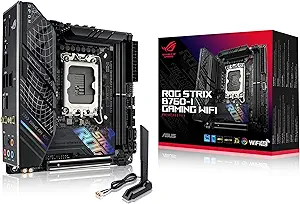
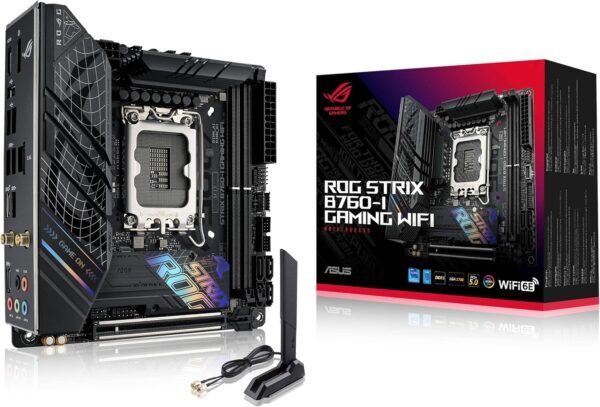
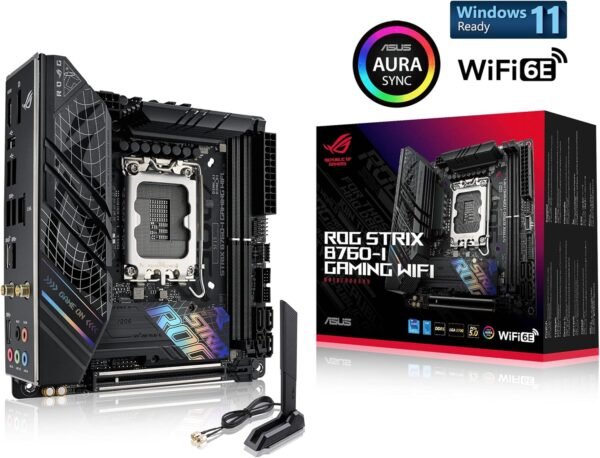
Description
The ASUS ROG Strix B760-I Gaming WiFi is a Mini ITX motherboard for Intel’s LGA 1700 socket, built on the B760 chipset. ASUS positions it for compact gaming builds around 13th generation Intel processors, and the specification reflects that: strong power delivery for the size, DDR5 support at high rated speeds, two M.2 slots and current networking.
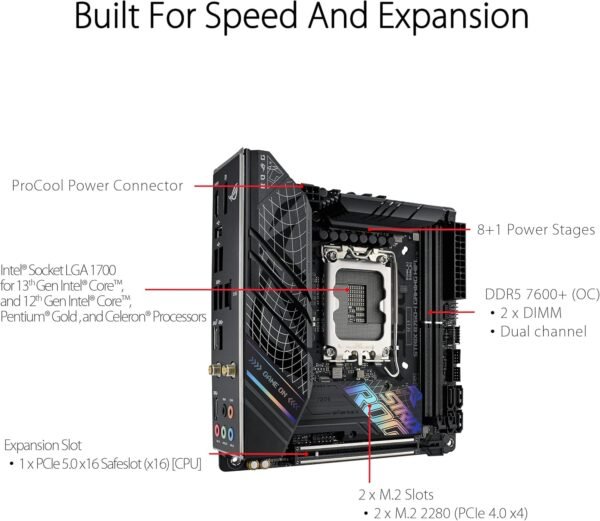
Compatibility first. The socket is LGA 1700, the chipset is B760, and the form factor is Mini ITX. ASUS lists support for 13th Gen Intel Core, 12th Gen Intel Core, Pentium Gold and Celeron processors. Builders comparing chipsets can look at the Z690 and Z790 boards in the motherboards category, such as the ASUS TUF Gaming Z690-Plus WiFi or the compact ASRock Z790M-ITX WiFi.
What B760 Gives And What It Does Not
B760 is Intel’s mainstream chipset for this socket, sitting below Z790. The practical difference is processor overclocking: Z series chipsets allow it, B series do not. Memory overclocking through XMP profiles is available on B760, so fast memory kits still work, but a K suffix processor cannot have its core multiplier raised on this board. Anyone buying an unlocked processor specifically to overclock it should choose a Z chipset instead.
There is a specification detail on this listing that needs unpacking rather than repeating. The product title lists PCIe 5.0, while the feature bullet describing storage says two PCIe 4.0 M.2 slots. Both can be true at once: on this platform the PCIe 5.0 lanes come from the processor and feed the main graphics slot, while the M.2 slots run at PCIe 4.0. The listing does not spell that out, so buyers expecting a PCIe 5.0 NVMe drive slot should confirm with ASUS before purchase. Practically, PCIe 4.0 drives are fast enough that this is rarely a real constraint.
Power Delivery And Cooling
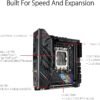
ASUS quotes an 8 plus 1 power stage design rated for 80 amps, supported by a ProCool power connector, alloy chokes and durable capacitors. On a Mini ITX board there is very little space for voltage regulation hardware, so 80 amp stages matter: a board that cannot sustain current will throttle a high core count processor under load regardless of how good the cooler is.
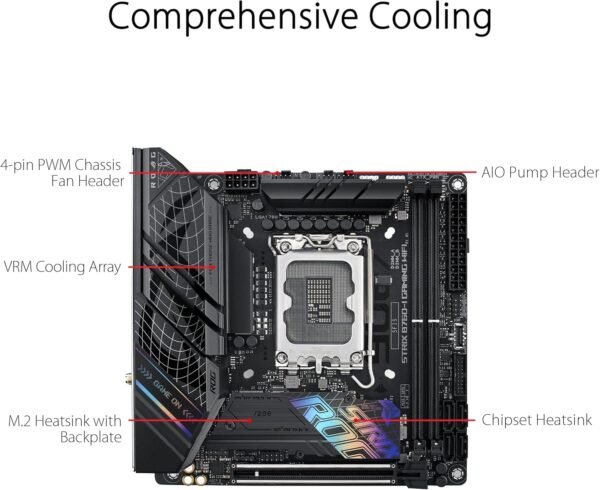
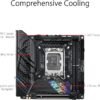
Thermal design follows the same logic. ASUS describes thick heatsinks bridged to the voltage regulation circuitry with high conductivity thermal pads, with the larger heatsink integrated into the input and output cover to add surface area. The description also mentions a skived fin design, which is a manufacturing method that produces thin closely spaced fins from a single block of metal for more surface area in the same volume. In a small case with restricted airflow, that surface area is doing real work.
Storage Layout, Networking And Extras
The two M.2 slots are arranged cleverly for the form factor. One sits on the front of the board under what ASUS describes as a substantial heatsink, and the second is mounted on the rear of the board specifically to save space. Rear mounting is a common Mini ITX solution and it works, with one caveat: a rear mounted drive is harder to reach after assembly and gets less airflow, so the slower or less frequently accessed drive belongs there.
Networking is Intel silicon on both sides, which is worth noting because Intel network controllers generally have the best driver support across operating systems. ASUS lists onboard Intel Wi-Fi 6E on 802.11ax and Intel 2.5 gigabit Ethernet with ASUS LANGuard surge protection, plus Bluetooth 5.3. USB includes a USB 3.2 Gen 2×2 Type-C port at 20 Gbps. Aura Sync RGB lighting is supported for anyone matching lighting across components.
Memory is DDR5, rated by ASUS at up to 7600 MT/s. That is a high figure and reaching it depends on the memory kit, the processor memory controller and a stable XMP profile rather than on the board alone. This board does not accept DDR4, so memory from a previous build cannot be reused.
Highlights
- Intel LGA 1700 socket with the B760 chipset in Mini ITX form factor.
- Supports 13th and 12th Gen Intel Core, Pentium Gold and Celeron processors.
- DDR5 memory rated up to 7600 MT/s.
- Two PCIe 4.0 M.2 slots, one heatsinked on the front and one rear mounted.
- 8 plus 1 power stages rated for 80 amps with a ProCool connector.
- Intel Wi-Fi 6E, Intel 2.5 gigabit Ethernet with LANGuard, Bluetooth 5.3.
- USB 3.2 Gen 2×2 Type-C and Aura Sync RGB support.
Things To Consider
The listing omits several specifications a builder needs. There is no DIMM slot count stated anywhere, no rear port list, no SATA port count, no fan header count and no statement of the maximum supported memory capacity. Mini ITX boards conventionally carry two DIMM slots because there is no room for more, but the listing does not confirm it, and buyers should check ASUS directly rather than assume.
The B760 chipset limits are worth restating because they are the most likely source of disappointment. No processor overclocking. Fewer chipset PCIe lanes than a Z series board. And with a single x16 slot on Mini ITX, a graphics card occupies the only expansion available.
Physically the package measures 7.3 by 3.8 by 9 inches and weighs 2.35 pounds, which describes the retail box rather than the board. Customer feedback is solid at 4.3 stars across 717 ratings on a board ASUS first listed in January 2023, which is a reasonable sample for a niche form factor. Builders should plan the cooler carefully, since LGA 1700 processors run warm and Mini ITX cases limit cooler height. Options are covered in the CPU cooling fans category, and processors in the Intel Core i7-14700 class need particular attention to thermal headroom.
Who It Suits
This board suits a builder assembling a compact Intel gaming system around a 12th or 13th generation processor, who wants DDR5, two NVMe drives, Wi-Fi 6E and 2.5 gigabit Ethernet without paying for a Z series chipset. The power delivery and heatsink design are appropriate for the form factor, and Intel networking silicon is a genuine plus for driver reliability.
It is the wrong board for anyone planning to overclock an unlocked processor, for builders who want PCIe 5.0 storage, for anyone reusing DDR4 memory, and for a build that needs more than one expansion slot. Buyers who need the full port and slot layout documented before ordering should consult ASUS directly, since this listing does not provide it.