


Description
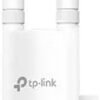
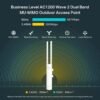
The TP-Link EAP225-Outdoor is a weatherproof dual band wireless access point built to extend a network beyond the walls of a building. It is not a router and not a consumer range extender in the plug into a socket sense: it is a ceiling or pole mounted access point that expects an Ethernet run and Power over Ethernet, and that slots into TP-Link’s Omada management platform. TP-Link rates it as an AC1200 class device delivering up to 1200 Mbps across both bands.
The target buyer is someone covering a yard, a patio, a warehouse loading area, a campsite or a small business forecourt where an indoor access point cannot reach and cannot survive the weather. For indoor only coverage or for a single household network, a conventional router such as the ASUS RT-AX1800S is the simpler answer.
Radio Specification And Rated Throughput
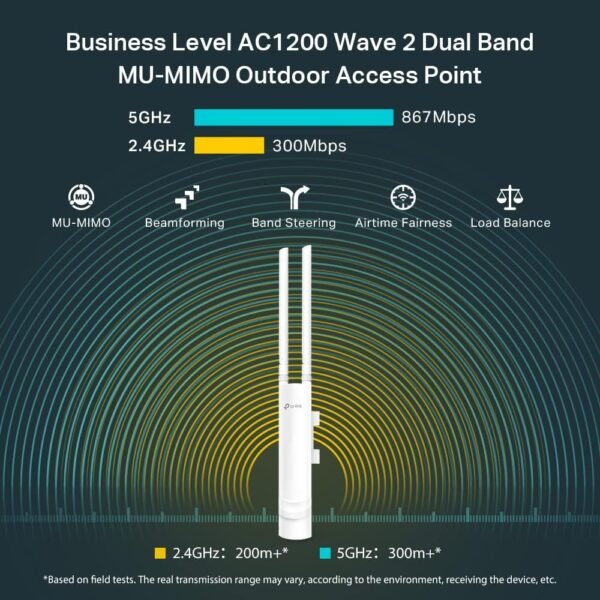
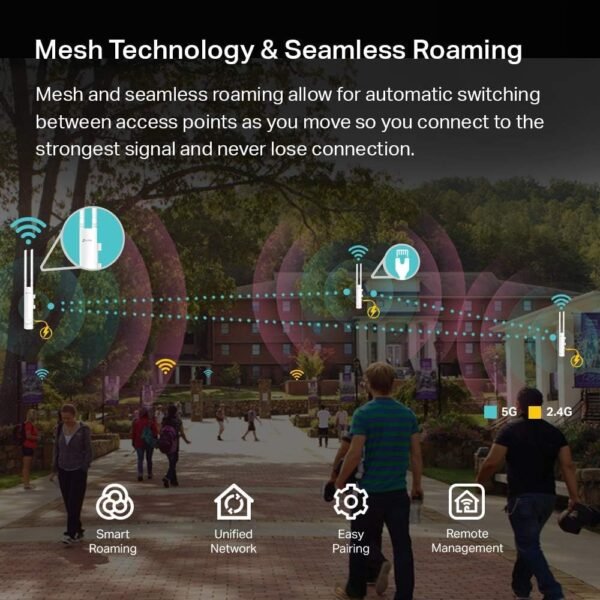
TP-Link lists 802.11ac Wave 2 with MU-MIMO, which allows the access point to serve several compatible clients at the same time rather than strictly one after another. The AC1200 rating is the combined figure across the 2.4 GHz and 5 GHz radios, which is how the whole industry quotes these numbers, so no single client will see 1200 Mbps. The listing also names Mesh Wi-Fi, seamless roaming, band steering, airtime fairness and beamforming as supported features.
Transmission power is given in the description as under 20 dBm at 2.4 GHz and under 27 dBm at 5 GHz for CE regulatory domains, and under 23 dBm at 2.4 GHz and under 22 dBm at 5 GHz for FCC. Those are regulatory ceilings, and the FCC figures are the ones that apply to buyers in the United States. TP-Link claims outdoor coverage beyond 200 meters at 2.4 GHz and beyond 300 meters at 5 GHz, which are line of sight marketing figures and should be read as best case rather than expected performance behind trees and buildings.
The Weatherproof Enclosure
TP-Link gives the housing an IP65 rating and lists an operating temperature range of minus 30 to 70 degrees Celsius, which is minus 22 to 158 degrees Fahrenheit, with operating humidity of 10 to 90 percent non condensing. Storage tolerance is listed slightly wider at minus 40 to 70 degrees Celsius. IP65 means protection against dust and against water jets, not submersion, so the unit is built for rain and spray rather than flooding.
The physical unit is small: 8.46 by 1.81 by 1.05 inches and 5.9 ounces by TP-Link’s own figures. The listing notes the discreet appearance suits indoor installation as well, so the same hardware can be used inside a garage or an unheated storeroom where a plastic bodied indoor unit would struggle.
Omada Management And PoE Options
This access point is designed around TP-Link’s Omada Software Defined Networking platform, which pulls access points, switches and gateways under one interface. Three controller options exist: an Omada hardware controller, an Omada software controller, and a cloud based controller for which TP-Link asks buyers to contact them for plan details. A standalone mode is also available for a single unit deployment with no controller at all.
There is an important compatibility warning in the listing. TP-Link states that SDN controllers work only with SDN access points, switches and gateways, and non SDN controllers work only with non SDN access points, and that buyers should check whether their specific device can be upgraded to SDN firmware. Anyone adding this unit to an existing Omada deployment needs to confirm firmware generation before ordering. For a fully integrated alternative that combines routing and controller duties, the Ubiquiti Dream Machine Special Edition takes a different approach to the same problem.
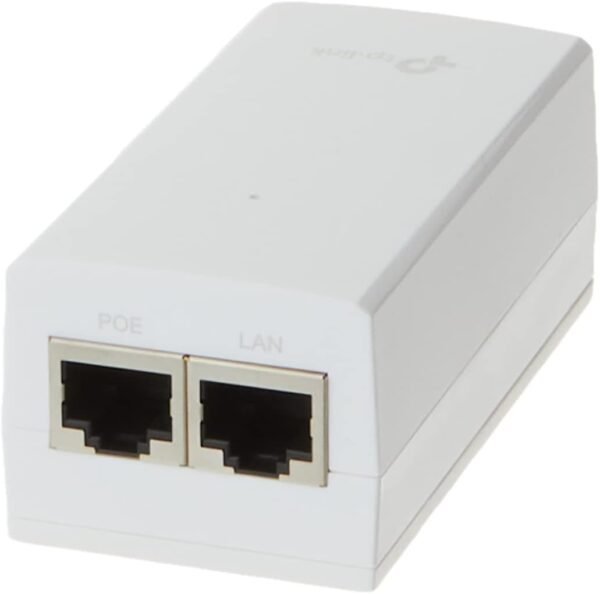
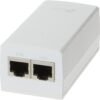
Power comes over Ethernet. TP-Link lists support for both 802.3af/at PoE and passive PoE, which gives installers flexibility between a PoE switch and a supplied injector. Wireless functions include a reboot schedule, the ability to disable the radios, and up to 16 SSIDs with 8 per band.
Highlights
- 802.11ac Wave 2 dual band radios with MU-MIMO, rated AC1200 combined.
- IP65 enclosure with a minus 30 to 70 degree Celsius operating range.
- Supports 802.3af/at PoE and passive PoE.
- Omada SDN integration with hardware, software, cloud or standalone control.
- Up to 16 SSIDs, 8 per band, with mesh, roaming, band steering and beamforming.
- Small 8.46 inch body at 5.9 ounces, mountable indoors or outdoors.
Things To Consider
Wi-Fi 5 is the headline limitation. This is an 802.11ac design that TP-Link first listed in January 2018, and newer client devices with Wi-Fi 6 or Wi-Fi 6E radios will fall back to the older standard here. That is a reasonable trade for outdoor coverage, where range and weather sealing matter more than peak throughput, but buyers who want current generation radios should know what they are giving up. A Wi-Fi 6 client adapter such as the EDUP AX3000M USB adapter gains nothing from this access point.
Installation is the second consideration and it is not trivial. An Ethernet cable has to reach the mounting point, and that cable has to be rated for outdoor use if it runs outside. There is no wireless uplink option in the standard configuration, so this is a wiring job rather than a plug in device. The listing’s specification block also contains two fields that clearly do not belong on a network product, listing Department as unisex and Language as English, which is import noise rather than a real attribute.
Customer feedback is strong at 4.3 stars across 7,548 ratings, and TP-Link backs the unit with what it describes as a limited lifetime warranty and 24/7 technical support. Readers building out a wider network can compare the other units in the wireless access points category or look at the wired side in the network cards category.
Who It Suits
The EAP225-Outdoor suits a property owner or small business that needs reliable Wi-Fi outside, already has or can run Ethernet to the mounting location, and either uses Omada already or is happy to run a single unit in standalone mode. It also suits anyone who wants central management across several access points without paying for enterprise licensing.
Skip it if the goal is a quick indoor coverage fix, if running a cable to the mounting point is not possible, if the network needs Wi-Fi 6 throughput, or if the buyer expects a router. This device provides wireless coverage only and needs a router and a DHCP source behind it.
