
Description
What The ASUS B85M-G Is
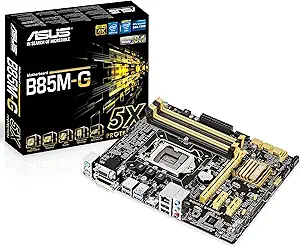
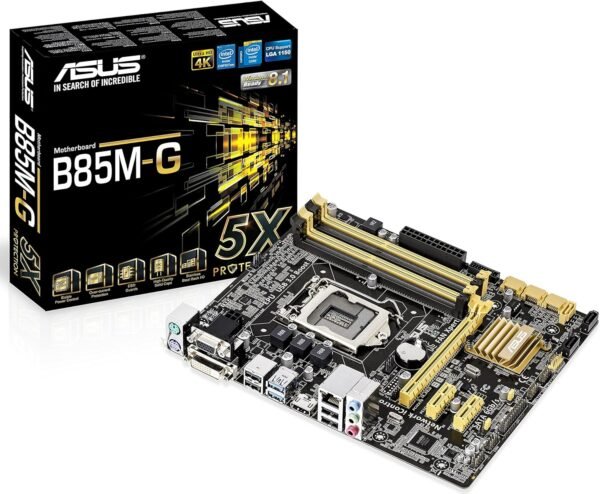
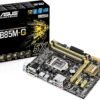
The ASUS B85M-G is a Micro ATX motherboard for the Intel LGA 1150 socket, using the B85 chipset and DDR3 memory. The product name states all three of those facts, which is more compatibility information than many listings in this catalog provide. B85 was Intel’s business and mainstream chipset for that socket generation, sitting below the Z series and without support for CPU overclocking.
The date on this listing is May 2013, and that is the most important context for any buyer. LGA 1150 and DDR3 are both retired platforms. New processors are not made for this socket and DDR3 is two memory generations behind current desktops. That does not make the board useless, but it does define who it is for, and the answer is repair rather than new construction. Anyone building today should be looking at current boards in the motherboards category.
Memory And Compatibility
The listing gives DDR3 at 1600 MHz and the specification table lists 32GB, which for a Micro ATX B85 board normally means four slots. It is worth being precise about what is not stated: the listing does not name the number of memory slots, does not list which Intel Core processor generations the socket accepts, does not name a chipset compatibility list, and makes no statement about BIOS versions or whether a BIOS update is required for any particular processor.
That last gap matters on LGA 1150 in particular, because the socket carried more than one processor generation and board support varied. The correct step is to check the ASUS support page for the B85M-G and match the exact processor model against the published CPU support list and its required BIOS version before buying a chip. Nothing on this product page allows that judgment to be made.
Feature Set
ASUS lists a familiar set of software and hardware extras for the era. 5X Protection is a hardware package ASUS describes as all round protection for quality, reliability and durability, typically covering surge protection, moisture resistance and overcurrent protection. USB 3.0 Boost with UASP support is quoted at 170 percent faster transfer speeds than traditional USB 3.0, a manufacturer figure measured under manufacturer conditions. Network iControl provides real time network bandwidth management, letting an application be prioritized over background traffic.
Fan Xpert gives dedicated CPU and case fan controls, Crash Free BIOS 3 restores corrupted BIOS data from USB storage, and AI Suite 3 collects the ASUS utilities into one interface. The board uses a UEFI BIOS rather than a legacy text BIOS, which was still a selling point when this board launched.
One more note on the format. Micro ATX is 9.6 inches square, smaller than full ATX but taking the same standoff pattern, so it fits both Micro ATX cases and any ATX case. That flexibility is the main practical reason to choose Micro ATX for a repair build, because the replacement board can go into whatever chassis is already on hand. What it costs is expansion slots, since Micro ATX boards typically offer fewer than a full ATX layout, and this listing does not state how many this board provides.
Highlights
- LGA 1150 socket and B85 chipset, both stated in the listing.
- Micro ATX form factor for compact and standard cases.
- DDR3 memory at 1600 MHz, listed up to 32GB.
- ASUS 5X Protection hardware package.
- USB 3.0 Boost with UASP support.
- Network iControl bandwidth management.
- Fan Xpert CPU and case fan control.
- Crash Free BIOS 3 recovery from USB storage.
- UEFI BIOS with AI Suite 3 utilities.
Things To Consider
Before the specific errors, the broader point is that this page publishes no slot layout, no port list and no rear panel description at all, so a builder cannot tell how many SATA ports, PCIe slots or USB headers the board carries without going to the manufacturer.
The specification table contradicts the product name on the single most important compatibility point. The product name says DDR3 1600 and the RAM field says 32 GB DDR3, but the Computer Memory Type field says DDR4 SDRAM. DDR3 and DDR4 modules are not interchangeable and do not physically fit the same slot, so buying memory based on that field would be an expensive mistake. The board is DDR3 according to both the product name and the RAM field. Elsewhere the table lists an item weight of 1.06 ounces, which is impossible for a Micro ATX board, and dimensions of 9.2 by 7.6 by 2.05 inches that describe the box rather than the 9.6 by 9.6 inch Micro ATX standard. The battery field reads CR2, where motherboard CMOS cells are normally CR2032.
- The memory type field says DDR4 while the board is DDR3. Do not buy memory from that field.
- LGA 1150 and DDR3 are both retired, so there is no upgrade path.
- Supported processor generations and BIOS requirements are not listed anywhere.
- The number of memory slots, PCIe slots and SATA ports is not stated.
- B85 does not support CPU overclocking.
- No onboard wireless is described.
- Weight and dimensions in the specification table are wrong.
Who Should Buy It And Who Should Not
The B85M-G makes sense for one situation: repairing or rebuilding an existing LGA 1150 machine where the processor and DDR3 memory are already on hand. In that case the ASUS feature set, the UEFI BIOS and the fan control are all useful, and replacing a board is far cheaper than replacing a platform. It is also a reasonable base for a secondary machine assembled from spare parts, and buyers in that position may find a compatible chip such as the era equivalent AMD A10-6800K useful for comparison of how much platforms have moved on.
It is the wrong purchase for a new build in every respect: old socket, old memory, no wireless, no M.2 described and no overclocking. Builders starting fresh should look at the GIGABYTE B365 HD3 for a later Intel platform, the ASRock B460M PRO4 for a newer Micro ATX board, or the ASRock Z390 Phantom Gaming 4 if overclocking matters. Owners of prebuilt machines needing a replacement board should also see the Dell XPS 8300 replacement motherboard for how those swaps differ.