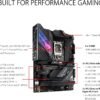
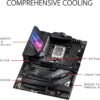
Description
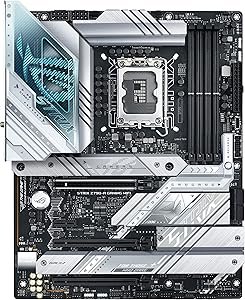
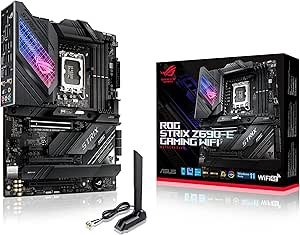
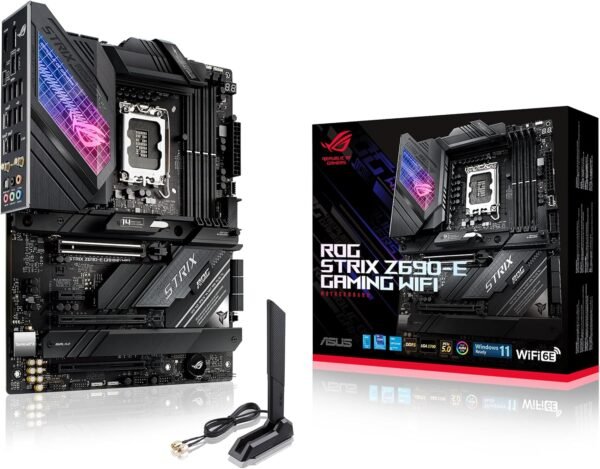
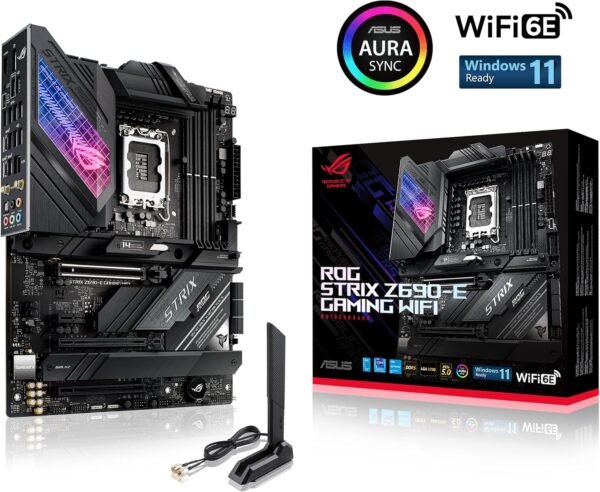
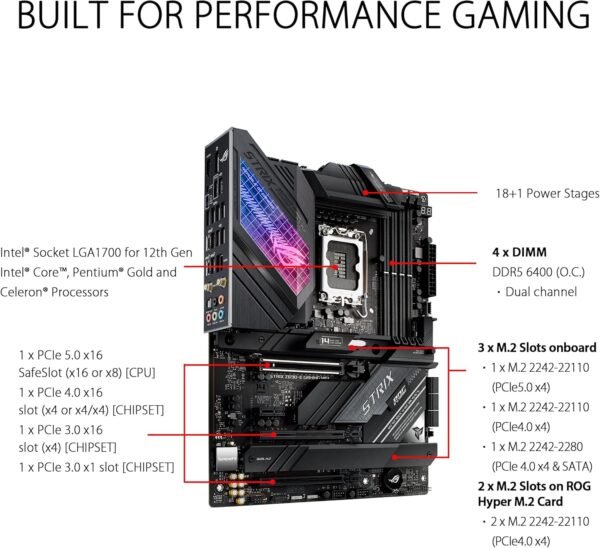
The ASUS ROG Strix Z690-E Gaming WiFi is a full size ATX motherboard for Intel’s LGA1700 socket, built on the Z690 chipset with DDR5 memory. ASUS specifies 18+1 power stages, PCIe 5.0, WiFi 6E and Intel Optane memory readiness, and lists processor support covering Pentium Gold, Celeron, Core i5, Core i7 and Core i9 parts. The listing dates to October 2021.
Compatibility First
The socket is LGA1700. The chipset is Z690. The form factor is ATX. Memory is DDR5, and this is the specification to be most careful about: the Z690 platform launched with both DDR4 and DDR5 board variants, they are not interchangeable, and a DDR4 kit will not fit this board. Check the memory you own or intend to buy against that before ordering anything.
ASUS names 12th Generation Intel Core processors in its description. The listing does not name later generations and says nothing about BIOS revisions anywhere. LGA1700 went on to carry later processor generations, but support for those depends on firmware, and this product page does not address it. If you intend to pair this board with a processor from a later generation, look your exact model up on ASUS’s own CPU support list for this board and note the BIOS revision it requires. A part such as the Intel Core i7-14700 is precisely the case where that check has to happen before you buy either component.
Note also the breadth of the stated processor support: Pentium Gold and Celeron appear alongside Core i9. That reflects the socket rather than any sensible pairing. Nobody puts a Celeron on a Z690 enthusiast board, and the chipset’s overclocking capability would be entirely wasted.
Power Delivery and Overclocking
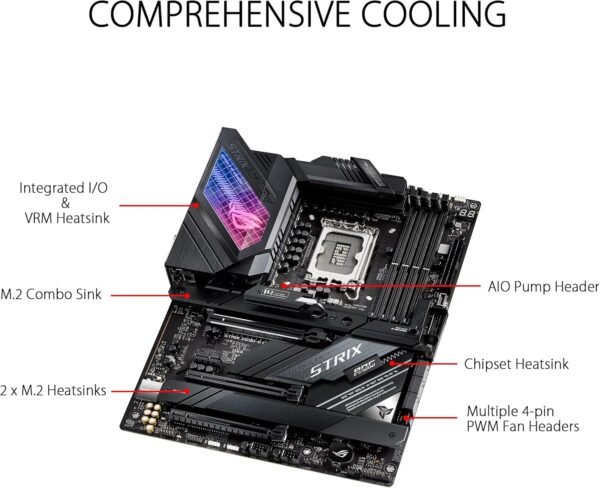
ASUS lists 18+1 power stages. That notation describes how the voltage regulation is divided: eighteen stages for the processor cores and one for auxiliary rails. Spreading current across more stages spreads the heat and lets the board hold voltage steady during sustained heavy load, which is what allows a high core count processor to maintain clocks rather than throttling.
Eighteen stages is a substantial arrangement and it is a large part of what places this board in the enthusiast tier rather than the mainstream one. Z is Intel’s overclocking chipset, so processor multiplier overclocking is supported here on unlocked parts, which lower tier chipsets such as B and H do not permit. ASUS describes optimized cooling alongside the power stages without quantifying it, and this page makes no claim about achievable overclocks.
Memory, PCIe and Connectivity
The specification block quotes DDR5 at 6400 MHz. Read that as an overclocked ceiling under favorable conditions with a validated memory kit, not as a guaranteed operating speed. DDR5 speeds depend heavily on the memory controller in the specific processor, the number of modules installed and the kit itself. Check ASUS’s memory qualified vendor list for this board before buying a kit specifically for its rated speed.
PCIe 5.0 is listed, which was new at the time of this board’s launch. The generation matters most for the primary graphics slot and, on boards that route it that way, for a fast storage slot. In practice, current graphics cards do not saturate PCIe 4.0, so the value of PCIe 5.0 here is future capability rather than present performance.
WiFi 6E is included on the board, adding the 6 GHz band to WiFi 6. That band is less congested than 2.4 GHz and 5 GHz because fewer devices can use it, and it requires a WiFi 6E capable router to deliver anything. Intel Optane memory readiness is listed, a feature of that platform generation that has since been discontinued as a product line, so treat it as historical rather than as a reason to buy.
Highlights
- Intel LGA1700 socket with the Z690 chipset in a full ATX board.
- DDR5 memory support, with a quoted overclocked ceiling of 6400 MHz.
- 18+1 power stages for processor voltage delivery.
- PCIe 5.0 support for the primary graphics slot.
- Onboard WiFi 6E wireless.
- Z series chipset, so processor overclocking is supported on unlocked parts.
- ROG Strix monochrome finish with an iridescent ROG logo and Aura lighting.
- Listed support spanning Pentium Gold through Core i9 processors.
Things To Consider
The specification block contains packaging data rather than board data: dimensions of 14.4 x 12.2 x 4.5 inches and a weight of 6 pounds describe the retail box, since an ATX motherboard measures 12 by 9.6 inches. A field listing 11 USB 2.0 ports is implausible as a rear panel count and probably totals ports and internal headers together.
Specifications the listing does not state and which should be checked in ASUS’s documentation: the number of M.2 slots and their generations, the number of SATA ports, how populating M.2 slots affects SATA availability, the number of memory slots and maximum capacity, and the full rear panel port list. None of these can be inferred from the chipset name.
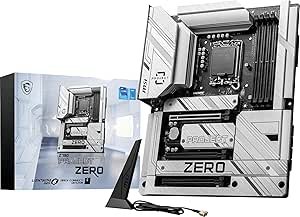
The larger consideration is platform position. Z690 was the first chipset generation for LGA1700 and has since been followed by later ones. Buying it now makes sense if you already own a compatible processor and DDR5 memory, or if the board is available at a price that reflects its age. Buying it as the base for a new build alongside a current processor requires the firmware check described above, and a later chipset such as the one on the MSI Z790 PROJECT ZERO removes that question.
Finally, be honest about whether you need the enthusiast tier at all. Eighteen power stages, PCIe 5.0 and WiFi 6E cost money, and a build with a mid range processor, one graphics card and one drive uses very little of it.
Who Should Buy It, and Who Should Not
Buy the ROG Strix Z690-E Gaming WiFi if you are building around an unlocked 12th Generation Intel processor, you have or want DDR5 memory, and you intend to overclock or run sustained heavy load where the power delivery matters. The WiFi 6E and PCIe 5.0 support give it more headroom than most boards of its generation.
Do not buy it if you own DDR4 memory, since this board will not accept it, and check the firmware situation carefully before pairing it with a later generation processor. Alternatives on the same socket include the ASUS TUF Gaming Z690-Plus WiFi and the GIGABYTE Z690 AERO G, while small form factor builders should look at the ASUS ROG Strix B760-I Gaming WiFi. Our motherboards category covers the wider range.