Description
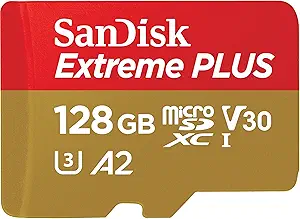
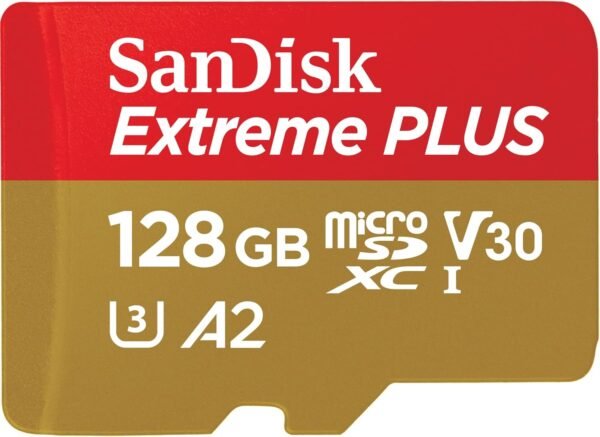
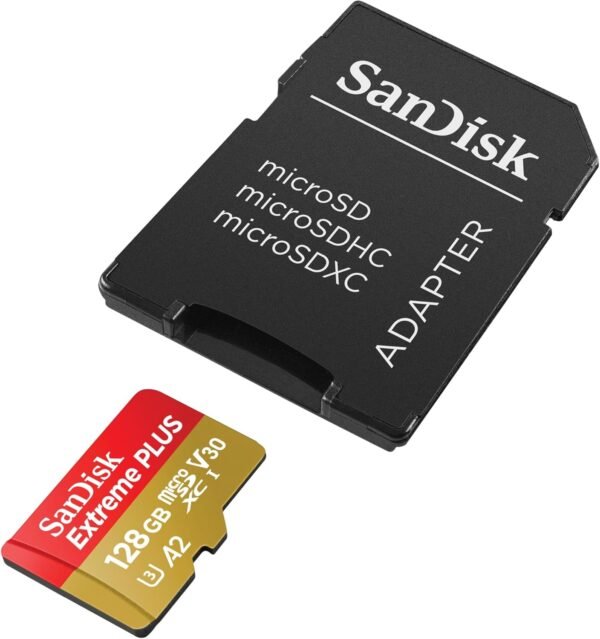
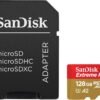
The SanDisk Extreme Plus 128GB is a microSDXC memory card, part number SDSQXBD-128G-AN6MA. The listing gives its ratings as UHS-I, Class 10 and V30, with speeds of 200 MB/s read and 90 MB/s write, and describes it as 4K capable.
There is no specification block and no description text on this listing beyond the product title, so what follows explains what those ratings actually mean, which is more useful than repeating them, and identifies what the listing does not say.
Decoding the Ratings
UHS-I
UHS-I describes the bus, meaning the electrical interface between the card and the device. It is the widely supported standard across cameras, phones, drones, handheld consoles and single board computers. UHS-I has a theoretical ceiling that the quoted 200 MB/s read figure approaches through a manufacturer specific mode; the important practical point is that the card is compatible with essentially anything that takes a microSD card, and that its read speed will only be realized in a host that supports the faster mode.
V30
This is the rating that matters most and the one most buyers skip. The V numbers describe minimum sustained sequential write speed: V30 guarantees at least 30 MB/s sustained. That is a floor, not a peak, and it is the number a camera cares about when recording video.
Video recording writes continuously for minutes at a time. If the card cannot sustain the bitrate, the camera fills its buffer and stops recording, which is the failure people experience as a camera that halts mid take. A peak write figure tells you nothing about this; the V rating does. V30 covers most 4K recording modes on consumer cameras and phones. Very high bitrate 4K and most 8K modes need V60 or V90, and this card does not carry those ratings.
Class 10 and the 90 MB/s write figure
Class 10 is an older rating guaranteeing 10 MB/s minimum sustained write. It is superseded by the V ratings and is included for compatibility with older device documentation. The 90 MB/s write figure is a peak, achieved when the card’s fast write cache is empty; once that cache fills during a long transfer, the sustained rate falls toward the V30 floor. Both numbers are true and they describe different conditions.
What This Card Suits
A 128GB V30 UHS-I card is the sensible general purpose choice for a phone, an action camera, a drone, a consumer camera shooting 4K, a handheld console or a single board computer. It has enough capacity to be useful and enough sustained write speed for standard 4K recording, without paying for ratings that most devices cannot use.
It is not the card for professional video work at high bitrates, and it is not comparable to the CFexpress format used in professional camera bodies. Those are a different physical card and a different interface entirely; the SanDisk Extreme PRO CFexpress Type-B is that other category and it will not fit a microSD slot.
For a tablet with a microSD slot, such as the Samsung Galaxy Tab A8, a card of this class expands media storage comfortably. Be aware that Android limits how much application data can live on removable storage, so treat a card as media and document space rather than as extra app capacity.
Highlights
- 128GB microSDXC card, part number SDSQXBD-128G-AN6MA.
- UHS-I bus, compatible with the widest range of devices.
- Quoted 200 MB/s read and 90 MB/s write speeds.
- V30 rating, guaranteeing at least 30 MB/s sustained write for video.
- Class 10 rating included for older device documentation.
- Listed as suitable for 4K video recording.
Things To Consider
The listing carries no specification block at all, which leaves several things unstated that a buyer might reasonably expect:
- No A1 or A2 application performance class rating is stated. That rating describes random read and write performance, which is what matters when a card runs apps on a phone or an operating system on a single board computer. If you plan either use, look for an A rating specifically rather than relying on the sequential speeds.
- No ingress, temperature, shock or X-ray ratings are stated. SanDisk markets durability claims on parts of its Extreme range, but nothing on this listing supports them, and this review makes no durability claim. Earlier copy on this page described the card as withstanding extreme temperatures, water and shock; that claim is not in the listing data and has been removed.
- No warranty term is stated.
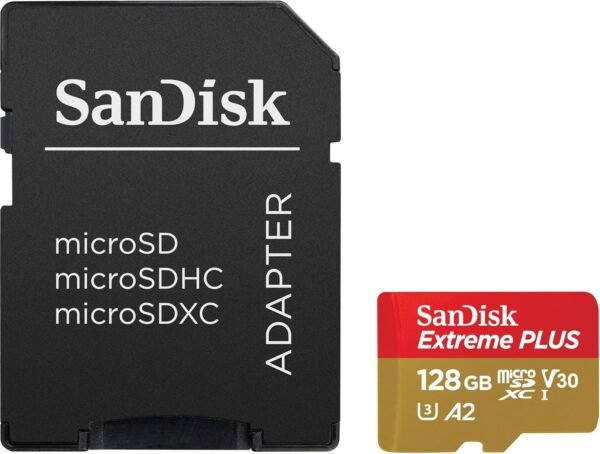
- No adapter is mentioned, so do not assume a full size SD adapter is in the box. Many microSD cards include one and some do not.
Two practical points beyond the specifications. First, your card reader is part of the equation: a 200 MB/s read speed requires a reader and a port capable of it, and an old USB 2.0 reader will cap transfers far below the card’s rating. Second, memory cards are consumable in a way people forget. Flash cells wear, and a card used for continuous video recording or as boot storage in a single board computer has a finite life. Back up anything you cannot lose, and replace cards used heavily rather than waiting for them to fail.
Finally, on capacity: 128GB in the SDXC format requires a device that supports SDXC. Very old devices that support only SDHC top out at 32GB and will not read this card. That is rare now but worth checking on older hardware.
Who Should Buy It, and Who Should Not
Buy this card if you need general purpose storage expansion for a phone, tablet, camera, action camera or drone, and you record video at standard 4K bitrates or below. V30 with 128GB is the sensible middle of the market: enough sustained write for the recording most devices actually do, at a capacity that lasts a trip rather than an afternoon.
Do not buy it for high bitrate professional video, where V60 or V90 is required, and do not buy it expecting an application performance rating for running apps or an operating system unless you confirm the A class separately. If what you need is a card for a professional camera with a CFexpress slot, this is the wrong format entirely. For moving files between a computer and a phone, a USB stick such as the SanDisk Ultra Dual Drive Luxe or its 256GB version is more convenient. Our micro SD cards category and SD cards category cover the formats we track.