Description
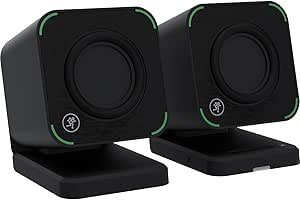
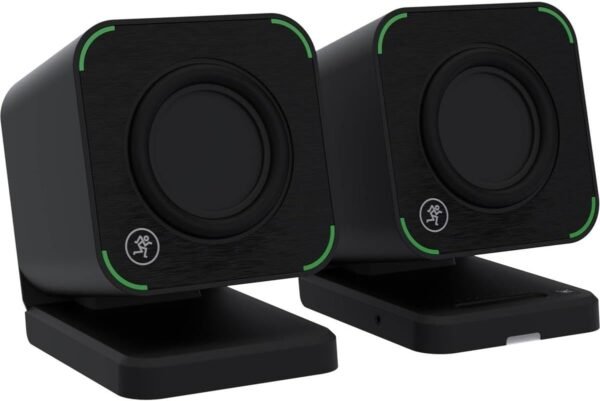
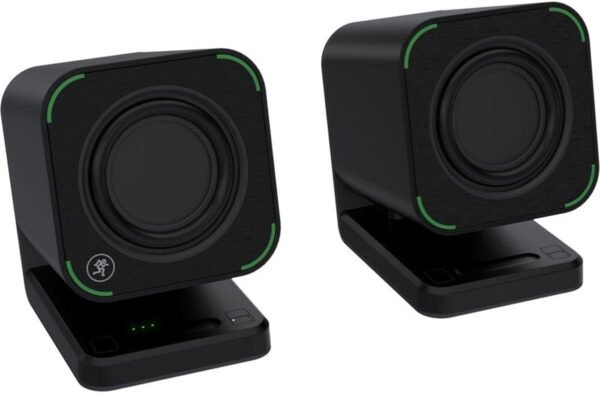
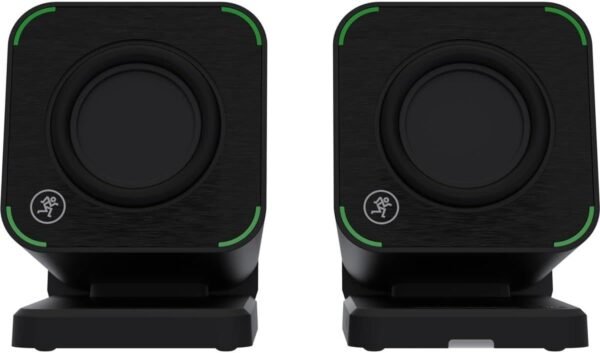
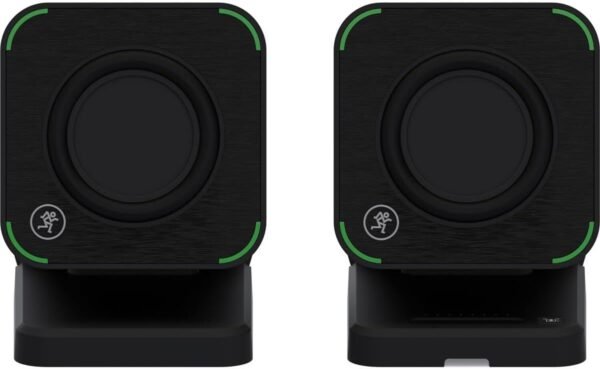
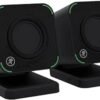
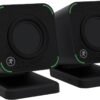
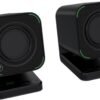
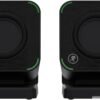
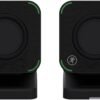
The Mackie CR2-X Cube is a pair of compact powered desktop speakers built around BMR driver technology, with three ways to get audio into them and two ways to get it out. Mackie is a professional audio brand, and the CR series is its consumer and creator focused desktop line, which shows in the feature set: this is a speaker set designed by people who expect a headphone output and a subwoofer output to be present.
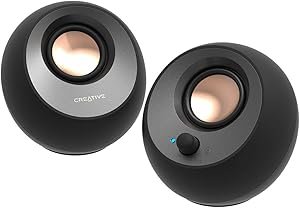
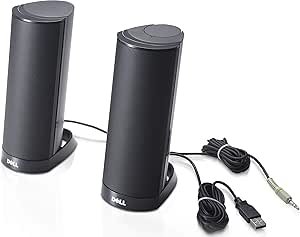
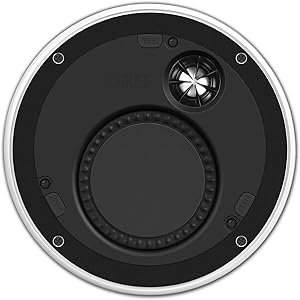
Buyers comparing desktop speakers should look at the Creative Pebble V3 at the budget end and the KEF Ci160ER at the other extreme, or the basic Dell AX210 if the requirement is only system sounds and calls.
BMR Drivers And What They Do
Mackie builds the pitch around BMR driver technology, which stands for balanced mode radiator. A BMR driver combines the pistonic motion of a conventional cone with the bending mode behavior of a flat panel, and the practical result is much wider dispersion than a typical small driver produces, particularly at higher frequencies.
That matters on a desk. Conventional small speakers beam their high frequencies forward in a narrow cone, so the sound changes noticeably if the listener leans left or right or stands up. Wider dispersion means the tonal balance holds up across a larger listening area, which is exactly the problem a desktop speaker faces when the listener is not sitting perfectly centered between two cabinets.
Note that the specification block reads Audio Driver Type: Planar Magnetic Driver, which contradicts the BMR description in Mackie’s own text. Planar magnetic and BMR are different technologies, and Mackie’s written description is the more reliable of the two here.
Connections
Three inputs is generous for a desktop pair and each serves a different purpose. USB provides a digital connection, meaning the speakers act as an audio device and perform the digital to analog conversion themselves rather than relying on the computer’s onboard audio. That bypasses noisy motherboard audio circuitry, which is a real improvement on many desktop machines. The auxiliary input takes an analog signal from a phone, a mixer or anything with a headphone output. Bluetooth handles wireless sources.
Two outputs are equally useful. A headphone output on the speaker means headphones can be plugged in at the desk rather than reaching behind a computer, and it mutes the speakers when used. The subwoofer output allows a powered subwoofer to be added later, and Mackie states the system optimizes itself when a sub is connected, naming its matching CR6S-X while confirming any other subwoofer will work. That upgrade path is worth having on a compact speaker set, since small cabinets cannot produce low bass and a subwoofer is the only real fix.
Control is by capacitive touch on the speaker for volume adjustment and mute, which Mackie presents as a cleaner look than physical knobs. Touch controls are a preference rather than an improvement: they are harder to adjust by feel without looking.
Physical Design
The listing gives dimensions of 4.7 inches deep by 9.5 wide by 6.5 high and a weight of 7.04 pounds. Those figures almost certainly describe the packaged pair rather than a single cabinet, since a set called Cube would be considerably smaller individually.
The configuration is 2.0, meaning two speakers with no subwoofer included, and the power source is mains rather than USB bus power, so a wall outlet is required. Use is indoor only and the speakers are not water resistant, which is expected for a desktop product.
Highlights
- BMR driver technology for wide dispersion from a compact cabinet.
- USB digital input, 3.5 mm auxiliary input and Bluetooth.
- Headphone output for private listening at the desk.
- Subwoofer output with system optimization when a sub is connected.
- Capacitive touch volume and mute controls.
- 2.0 configuration running from mains power.
- From Mackie, an established professional audio manufacturer.
Things To Consider
The most significant omission is power output. There is no wattage figure anywhere on this listing, per speaker or total. For a powered speaker set that is the headline specification, and its absence makes any comparison against a competitor impossible on paper. There is also no frequency response range, no driver size that can be trusted, no signal to noise ratio and no statement of what cables are included beyond the components field reading simply speakers.
Several specification fields are wrong. Speaker Type reads Computer, Subwoofer, though no subwoofer is included. Subwoofer Connectivity Technology reads Wireless, though the subwoofer output is a wired jack. Speaker Size reads 5.25 inches, which is implausible for a compact cube design and inconsistent with the product name. Recommended Uses For Product reads Volume, which is not a use.
Customer feedback is thin at 4.1 stars across 68 ratings, on a product first available in September 2022. Sixty eight ratings is a small sample and 4.1 is a middling average, so buyers should read the reviews individually rather than relying on the number.
The other practical consideration is that these are desktop speakers rather than studio monitors, despite the Mackie name. Mackie’s CR line is positioned for casual creation and general listening, not for critical mixing, and the marketing language about room filling sound should be read accordingly. Anyone doing serious audio work should look at dedicated monitors. Readers can compare alternatives in the computer speakers category, and those needing a microphone alongside them should see the computer microphones category.
Who It Suits
The CR2-X Cube suits a desk where the speakers need to serve several sources, where a headphone output within reach is genuinely useful, and where a subwoofer might be added later. The USB input in particular makes it a sensible pairing with a computer whose onboard audio is poor, and the wide dispersion of the BMR drivers suits a desk where the listener moves around.
It is the wrong choice for anyone who needs a documented power output before buying, for critical audio work where studio monitors are the right tool, for buyers who prefer physical volume knobs, and for setups with no spare mains outlet, since these are not USB powered.