Description
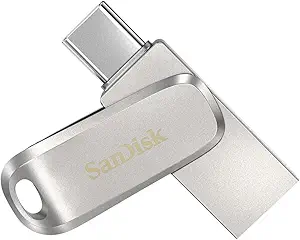
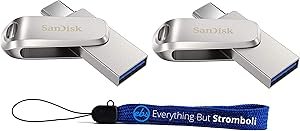
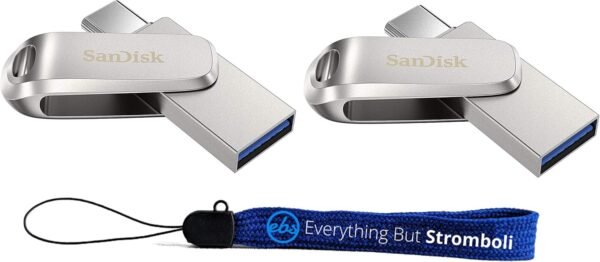
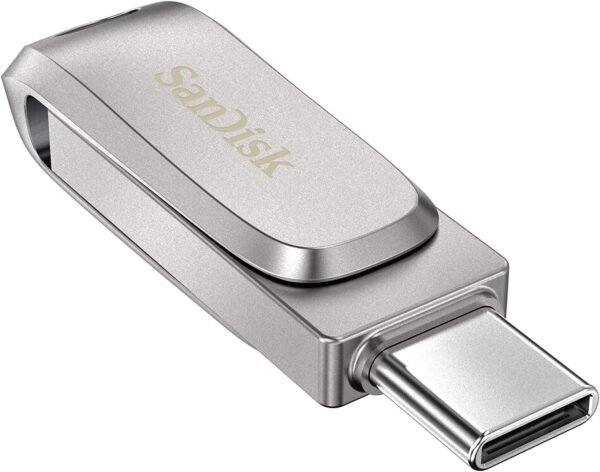
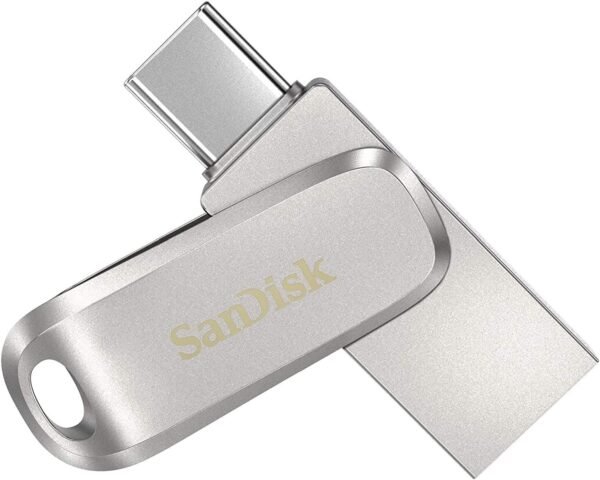
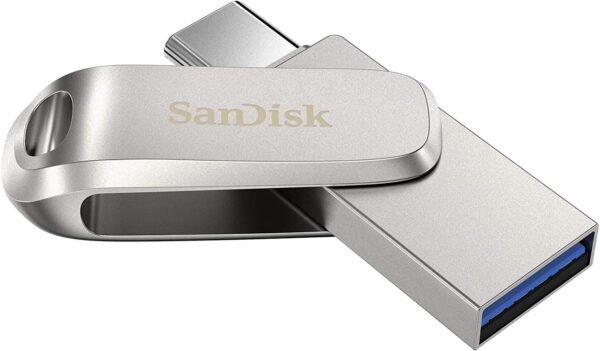
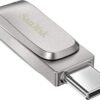
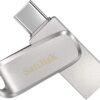
The SanDisk Ultra Dual Drive Luxe is a USB flash drive with two connectors: a reversible USB Type-C on one end and a traditional USB Type-A on the other. This listing sells two 128GB drives in bulk packaging, bundled by the seller with a lanyard. SanDisk quotes USB 3.1 speeds of up to 150 MB/s, and the drive is built from metal with a swivel body and a key ring loop. The part number is SDDDC4-128G-G46 and the listing dates to November 2020.
Why Two Connectors Matter
The dual connector design is the entire point of this product and it solves a specific, common problem: moving files between a phone and a computer without cloud storage, cables or software.
A conventional USB-A drive plugs into a laptop but not into a phone. A USB-C only drive plugs into a phone and a recent laptop but not into the older USB-A ports that most desktops, televisions, cars and public machines still use. A drive with both ends works everywhere without an adapter, and the swivel body means the unused connector is protected rather than exposed.
SanDisk names the use case directly: freeing up space on a smartphone and moving content between Type-A and Type-C devices, including Android smartphones, tablets and Macs with a USB-C port. Note the qualifier SanDisk attaches to phone use, which is OTG support, meaning on-the-go host mode. A phone must support USB OTG to read a flash drive at all. Most current Android phones do; check yours if you are buying specifically for that.
The swivel design also means there is no cap to lose, which on a drive carried on a keyring is a practical rather than a cosmetic advantage. The metal body adds protection over the plastic used on cheaper drives.
Reading the Speed Figure
SanDisk quotes up to 150 MB/s over USB 3.1. That is a read speed, and the listing does not state a write speed anywhere. This distinction matters more than most buyers realize.
On flash drives at this level, write speed is typically far lower than read speed, sometimes by a factor of three or more, and write speed is what determines how long it takes to copy files onto the drive. If you are moving a large folder of photos or video from a computer to the drive, the write speed governs the wait. Ask or check SanDisk’s own specification sheet if that number matters to your use.
Also note that 150 MB/s requires a USB 3.1 port at the other end. Plugged into a USB 2.0 port, which many older machines, televisions and cars have, throughput drops to a fraction of that figure. The drive still works; it is simply limited by the slowest link.
What the Bulk Two-Pack Means
The product title describes this as a bulk two-pack. Bulk packaging generally means the drives arrive without individual retail boxes, which is a cost saving and has no effect on the product itself. Two drives is genuinely useful: one for a bag and one for a desk, or one for you and one for a household member, or a working copy and a backup.
The lanyard included is bundled by the reseller rather than by SanDisk, which is worth noting when thinking about who handles a warranty claim. Confirm the warranty arrangement with the seller if that matters to you, since the listing states no warranty term.
Highlights
- Two 128GB Ultra Dual Drive Luxe drives per pack, in bulk packaging.
- Reversible USB Type-C connector on one end, USB Type-A on the other.
- USB 3.1 with quoted read speeds up to 150 MB/s.
- Metal construction with a swivel body and no cap to lose.
- Key ring loop for attaching to a lanyard or keys.
- Works with Android phones and tablets that support USB OTG, and with Macs and PCs.
- Part number SDDDC4-128G-G46, bundled with a reseller supplied lanyard.
Things To Consider
The main gaps in this listing are the write speed, already covered, and the absence of any durability rating. Flash drives are carried in pockets and bags, and while the metal body is more robust than plastic, the listing states no water, drop or temperature rating. Do not assume a metal case means a rugged drive.
Two practical points about flash drives generally. First, a USB stick is not a backup. Flash memory in a small drive has limited write endurance and, more importantly, a keyring drive is the single easiest thing in your possession to lose. Use it for transfer and convenience, and keep the authoritative copy somewhere else. Second, unencrypted flash drives are a real data exposure risk if lost. If you carry anything sensitive, use operating system level encryption on the drive.
On format compatibility: flash drives ship formatted for the widest compatibility, which usually means a file system with a single file size limit around four gigabytes. If you plan to move large video files, you may need to reformat, and the format that works on a phone is not always the format that works on every computer. Worth knowing before you find out mid transfer.
Finally, be aware that this site also lists a 256GB version of the same drive family under a separate page. The design and connectors are the same; only capacity and packaging differ.
Who Should Buy It, and Who Should Not
Buy this two-pack if you regularly move files between a phone and a computer, you want a drive that plugs into both without an adapter, and having a spare is useful. The metal body and swivel design make it a sensible thing to keep on a keyring, and 128GB is enough for documents, photos and a reasonable amount of video.
Do not buy it as a backup solution, and do not buy it if write speed is your priority without checking that figure first. If your need is expanding a phone or tablet’s internal storage rather than transferring files, a memory card such as the SanDisk Extreme Plus 128GB microSDXC is the better route for a device such as the Samsung Galaxy Tab A8. For camera storage, neither format applies and a CFexpress card may be what your body requires. The 256GB version of this drive is the larger option, and our USB flash drives category covers the rest.